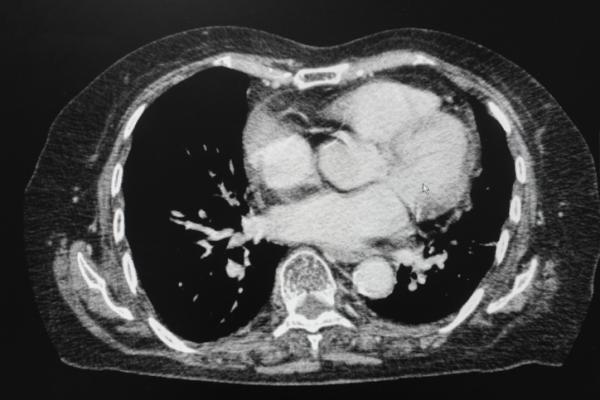
October 3, 2023 — Using previously taken diagnostic computed tomography (CT) scans in place of CT simulation scans to plan simple palliative radiation treatments can substantially reduce the time some people spend waiting for urgent treatment, improving the patient experience, a new study suggests.
Patients who may benefit from this expedited process typically are experiencing pain or other debilitating symptoms, such as an airway blockage. Relying upon existing, recent scans instead of taking new ones reduced the time these patients spent at a cancer treatment center, from nearly five hours to under 30 minutes, on average, providing a pathway for expedited care. Findings will be presented today at the American Society for Radiation Oncology (ASTRO) Annual Meeting.
“This novel workflow for palliative radiation treatment planning can have major benefits for patients who need urgent palliation, as well as for health systems,” said lead study author Melissa O’Neil, MRT(T), MSc, an advanced practice radiation therapist at the London Health Sciences Centre in Ontario, Canada.
“There are a lot of ripple effects from reducing the time a patient spends in a cancer center. When treatment can begin more quickly, patients can have their symptoms relieved faster. Using existing scans can also reduce costs and opens time slots in the clinic’s schedule for us to see and help more patients,” she said.
Palliative radiation therapy is used to relieve symptoms in patients whose cancers cannot be cured. Often, it is prescribed when tumors are causing the patient pain, neurologic symptoms or respiratory problems, such as blocking an airway.
Under the current standard of care, patients referred for palliative radiation must undergo a CT simulation scan before they can receive treatment. CT simulation generates 3D images that are used by the patient’s care team to create a custom radiation treatment plan for the patient. This process usually takes several hours, even when using expedited workflows.
Yet many of these patients have also undergone a recent diagnostic CT scan, performed in medical imaging departments outside of the cancer center as a part of routine follow-up or other care. Previous research found that radiation oncology teams could produce clinically acceptable palliative treatment plans for patients with bony and soft tissue metastases using these existing diagnostic CT scans, rather than the more time-intensive simulation scans. In the current study, O’Neil and her colleagues investigated whether using existing CT scans to plan treatment ahead of a patient’s arrival could reduce their time at the cancer center while still delivering appropriate care.
Thirty-three patients needing palliative radiation for tumors in their thoracic, abdominal, pelvic or proximal limb areas were randomized to either standard treatment planning with on-site CT simulation scans, or to treatment planned before their appointment using diagnostic CT scans taken up to 28 days prior.
Treatments were delivered to bony soft tissue metastases (25 patients, or 76%) or visceral lesions, which are soft tissue lesions that occur outside of the bones (8 patients, or 24%). The median patient age was 72 years old. The most commonly prescribed radiation doses were 8 Gy in one fraction (50% of plans) and 20 Gy in five fractions (43% of plans).
Researchers measured how much time each patient spent at the cancer center on the day of treatment, from the time of their appointment to completion of treatment delivery. Patients in the standard treatment planning group spent nearly five hours (4.8 ± 1.1 hours), on average, at the cancer center, compared to just under half an hour for those not receiving CT simulation scans (0.4 ± 0.1 hours) (p<0.001).
“With this new workflow, the planning is all done before the patient arrives,” O’Neil said. “So, when the patient comes to the center, they’re in and out. That’s a significant reduction in time burden.”
All treatment plans in both arms were delivered successfully. Anonymized treatment plans were reviewed by a team of independent physicians for adequacy of target coverage, and dose distribution was rated acceptable (80% in the control arm, 81% in the dCT arm) or acceptable with minor deviation (20% in the control arm, 19% in the dCT arm).
The researchers also surveyed patients, radiation therapists, medical physicists and radiation oncologists at the cancer center to measure how acceptable they perceived the novel workflow to be.
Half of the patients in the standard planning group rated the time they spent at the cancer center as acceptable, compared to 90% of those whose diagnostic CT scans were re-used for treatment planning (p=0.025). With the exception of time burden, patients in both groups had a similar perception of whether their treatment experience was acceptable. On a five-point scale of acceptability, 90% of clinical stakeholders rated the new workflow as four or higher.
While the study results are promising, O’Neil emphasized that reusing diagnostic scans is not appropriate for all types of cancers or patients. “We also have to be treating an area that’s compatible with this type of technique,” she said.
For example, diagnostic CT scans do not require a patient’s head to be reproducibly immobilized, so they cannot be used to plan treatment for brain tumors. But they are appropriate for patients who need simple palliative radiation for pain control and symptom management.”
For more information: www.astro.org

 October 13, 2026