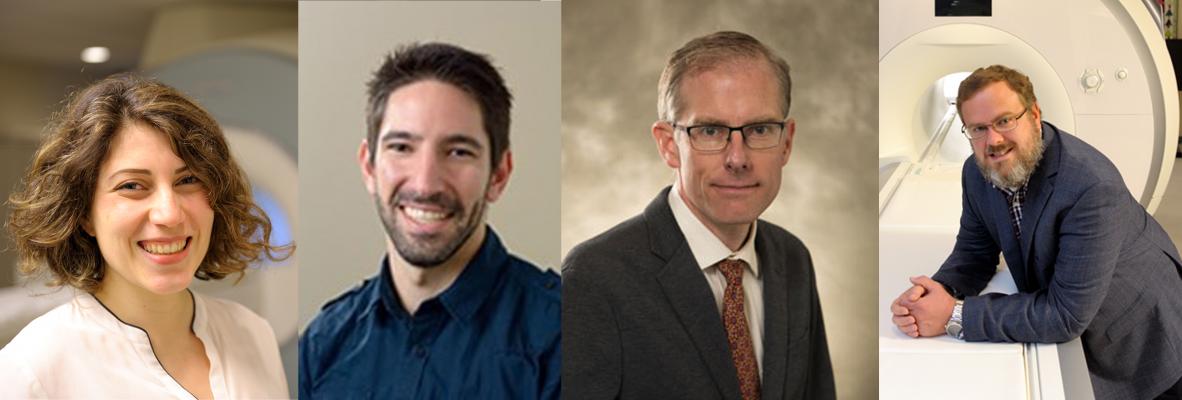
A team of psychologists and neuroscientists at the Beckman Institute for Advanced Science and Technology including Sepideh Sadaghiani, Maximillian Egan, Ryan Larsen, and Brad Sutton published a study to establish safe use of electroencephalography coupled with newly developed functional MRI sequences. Image courtesy of the Beckman Institute for Advanced Science and Technology.
September 7, 2021 — A team of psychologists and neuroscientists at the Beckman Institute for Advanced Science and Technology led by assistant professor of psychology Sepideh Sadaghiani and graduate student Maximillian Egan published a study to establish safe use of electroencephalography coupled with newly developed functional magnetic resonance imaging (MRI) sequences.
In recent years, the field of fMRI has seen drastic improvements in a new type of scan called multiband imaging. fMRI, which examines brain function through a mechanism based on oxygenation of the blood, can be a slow technique. With the newer multiband fMRI imaging sequences, scientists can scan the brain faster and in higher resolution, enabling more detailed insights into brain organization and function.
The Sadaghiani lab at Beckman is coupling this faster fMRI scanning with EEG data to quickly obtain information on electrical signaling in the brain.
Because multiband fMRI imaging is a new technology, conducting it safely requires re-examining existing protocols. Experimentation revealed that multiband sequences’ increased speed can heat the body and EEG electrodes much faster than single-band sequences. This is concerning when electrodes are placed around the subject’s head, which occurs when fMRI imaging is coupled with EEG data collection.
This makes faster multiband imaging a double-edged sword, accelerating the imaging process and requiring care to maintain safe use by keeping the heating at the EEG electrodes in check.
Collaborating with Ryan Larsen, a research scientist at Beckman, and Brad Sutton, a professor of bioengineering and the technical director of Beckman’s Biomedical Imaging Center, Egan and colleagues established safety and data quality standards for game-changing neuroscientific assessment technology that will allow scientists using multiband EEG-fMRI to predict the heating output while using this technique, and design protocols to reduce heating down to single-band levels.
To predict the heating achieved with new operating sequences, the research team carried out comparative heating studies using single-band and multiband sequences. The comparative studies showed that while using specific operating sequences, the heating seen in multiband imaging is comparable to that seen in single-band imaging. The team also mitigated the presence of artifacts observed due to the employment of these complex imaging techniques, helping to define standards for acceptable data using safe multiband imaging sequences.
“This safety study facilitates a comprehensive understanding of brain function through the concurrent recording of EEG with accelerated fMRI. As an example, our lab uses this approach to study the human brain’s connectome (whole-brain neural connectivity pattern) at unprecedented spatial and temporal resolution,” Sadaghiani said.
This study is indicative of the collaborative efforts that are needed to develop, establish, and standardize the new technologies that propel science today. The Beckman Institute is a center for such collaborative efforts, leveraging diverse expertise to advance imaging science and our understanding of the brain.
For more information: https://beckman.illinois.edu/

 October 08, 2026