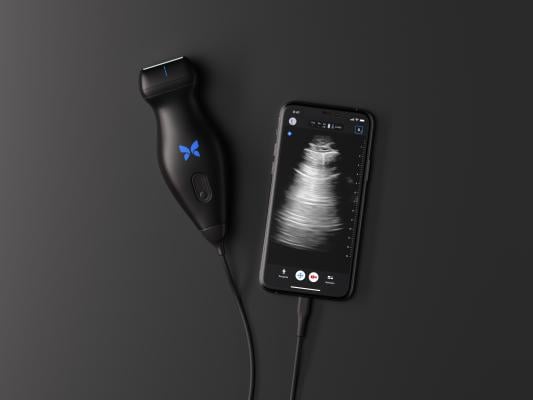
June 4, 2021 — Currently headed for the International Space Station, the 22nd SpaceX Dragon cargo resupply payload includes a Butterfly iQ, the world's first handheld, single-probe whole-body ultrasound system using semiconductor technology. This tool was developed by Butterfly Network, Inc., an innovative digital health company that is working to democratize medical imaging and contribute to the aspiration of global health equity. The Translational Research Institute for Space Health (TRISH) at Baylor College of Medicine is supporting the product’s first user demo in space.
TRISH is a consortium research institution led by Baylor College of Medicine’s Center for Space Medicine. The institute invests research dollars in cutting-edge terrestrial healthcare technologies that can protect astronaut health and performance. Recognizing the valuable information delivered by Butterfly iQ, a potential game-changer for space health, the institute is supporting a research team from KBR, based in Houston, that will evaluate how the Butterfly iQ performs in the hands of the astronauts in space. The TRISH team hopes to demonstrate the portability, ease-of-use and durability of Butterfly’s technology in extreme environments.
“NASA is returning to the moon and our astronauts will need to be more self-reliant when it comes to medical care. TRISH is investing in innovations that enable healthcare to be provided in new ways,” said Dorit Donoviel, M.D., director of TRISH. “On deep space missions, tools such as the Butterfly iQ will help the astronauts monitor themselves for concerns such as kidney stones, fluid in the lungs, blood clots and swelling of the optic nerve.”
Once delivered to the space station, astronauts will provide feedback on the ease of using the device, the quality of the produced ultrasound images and the efficiency of image acquisition.
“We’re thrilled that TRISH has identified the potential of Butterfly iQ to advance care delivery in remote – and extremely remote – care settings. We are confident that the iQ’s combination of diagnostic power, portability, reliability and ease of use will prove a useful addition to the medical toolkit of the International Space Station,” said Todd Fruchterman, M.D., president and chief executive officer of Butterfly Network. “It is an honor to know that a Butterfly device will help NASA safeguard the health of its incredible astronauts by providing actionable diagnostic insights.”
Butterfly’s technology will continue to make an impact in a wide variety of care settings, providing valuable information to help make clinical decisions earlier in a patient’s treatment – in the hospital, in medical transport on the way to the hospital, in the clinic, and ultimately, subject to appropriate regulatory authorization, in the home.
For more information: www.butterflynetwork.com
Related Butterfly iQ Content:
5 Key Trends in Ultrasound Systems
Point-of-care Ultrasound Sees Rapid Growth Amid COVID-19 and May be Poised for Consumers
Butterfly Network Releases New Version of Point-of-Care Ultrasound Platform With Butterfly iQ+
Utility of Point-of-Care Ultrasound Across Clinical Applications Spurs Continued Growth
VIDEO: Imaging COVID-19 With Point-of-Care Ultrasound (POCUS)

 October 23, 2026