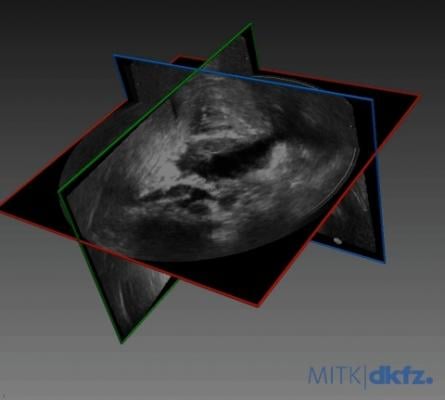
New Module Creates a Warped MRI Scan that Matches Real-Time Ultrasound Results (Graphic: Business Wire)
May 7, 2021 — RSIP Vision, an experienced leader in driving innovation for medical imaging through advanced artificial intelligence (AI) and computer vision solutions, announced today a new prostate MRI-to-ultrasound registration tool. The tool’s fully automated, deep learning-based capabilities provide a robust method that utilizes a registered MRI scan of the prostate to visualize information on top of an in-op ultrasound image. This provides the surgeon accurate, real-time information on regions of interest inside and near the prostate, visible mainly on the MRI scan. This may include tumors, NVB, the sphincter and other relevant regions.
“MRI-to-ultrasound technology is a highly empowering tool for a surgeon to have,” said Ron Soferman, CEO of RSIP Vision. “By having RSIP Vision’s new prostate MRI fusion tool at their fingertips, surgeons can avoid damaging sensitive internal structures. They can also locate clinically relevant regions and reduce procedural risks to patients. Our new tool also cuts down on surgery time, hospitalization time and overall procedural costs. Most importantly, it gives surgeons the ability to make quick and accurate clinics decisions mid-procedure, alleviating the need to call for higher-level expertise.”
In prostate-focused procedures, lack of information makes the surgeon’s decision process a challenging task. Currently, only a limited set of tools exists to provide surgeons with a better understanding of the location of the clinically important regions. While ultrasound alone is commonly used, certain regions simply cannot be clearly viewed by ultrasound.
RSIP Vision’s newly-developed tool can be used in frequent clinical tasks, such as biopsy acquisition, robotic prostate surgeries and more. During these procedures, valuable MRI information is typically not available due to the complicated nature of its acquisition in real-time. By scanning the patient prior to surgery, it’s possible to merge the MRI image to an ultrasound scan that is acquired during surgery. By doing so, the warped MRI image can be created in real-time, and locations of relevant regions can be displayed for the surgeon as it would if real-time MRI acquisition were possible. This capability gives a surgeon many options, such as improved navigation to a tumor during biopsy or sparing the neurovascular bundle during prostate removal surgeries.
“The ability to see MRI images presented as an overlay, on top of a real-time ultrasound, during urological procedures is substantial,” said Roni Gilad, M.D., a Senior Urologist at Rabin Medical Center in Israel. “It allows us to detect the different tissues and organs accurately and quickly, clearly detect important borders, contributing to a shorter procedure and an improved outcome.”
Consistent with RSIP Vision`s preceding reliable solutions, this new tool is vendor-neutral and available to third-party medical device and application vendors. The initial version will provide MRI-to-ultrasound registration using standard MRI scans and trans-rectal ultrasound images. Going forward, RSIP Vision plans to extend the module’s capabilities to use various types of ultrasound scanners and provide higher accuracy by guiding physician’s to correctly place the ultrasound probe, thus providing for more clean and consistent images that will increase the module’s accuracy.
For more information: www.rsipvision.com

 October 07, 2026