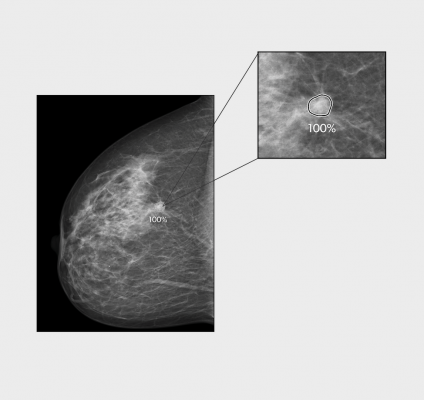
April 2, 2021 — iCAD, Inc. announced that ProFound AI for 2D Mammography might notably reduce the risk of interval breast cancer, according to a retrospective analysis recently published in the Journal of Medical Screening.
The aim of the study was to determine if adding artificial intelligence (AI) to reading mammography as a supportive tool may help in decreasing the interval cancer rate in population-based organized mammography screening programs in Germany.
“Interval breast cancers—cancers that are diagnosed after a negative mammography screening, but before the next recommended screening exam, can be linked to a poor prognosis such as cancer that has already spread, or a more aggressive type of cancer, thus underscoring the need for iCAD’s deep-learning algorithm that can analyze each mammography image and provide critical insight into individual cases,” said Michael Klein, Chairman and CEO of iCAD. “The data from this retrospective analysis are very encouraging in Europe while also having an impact on screening in the US. The results further stress the importance of our ProFound AI platform as a world-class artificial intelligence (AI) solution offering benefits to radiologists and women in improving breast cancer detection rates, reducing false positives and unnecessary callbacks, and providing more personalized screening for every woman.”
In the retrospective analysis, which evaluated a screening period from 2011 and 2012, a total of 37,367 women between the ages of 50-69 were screened with full-field digital mammography (FFDM). Of these, 29 cases of interval cancers with full documentation were evaluated using ProFound AI for 2D Mammography. For quality assurance, interval cancers with the prior screening mammogram were classified in four categories by the radiologists: true interval cancers, minimal sign cancers, missed cancers (false negative) based on the original screening exam deemed as normal and dismissed, and occult cancers. The objective of the study was to determine whether ProFound AI for 2D Mammography could identify interval cancers that had either minimal signs in the original normal screening or were missed in the original screening round where they had been dismissed as a normal exam.
According to the lead author of the study, Axel Gräwingholt, M.D., Radiologie am Theater in Paderborn, Germany, “The results indicate that ProFound AI for 2D Mammography found 93% of these cancers—eight out of nine cancers that presented minimal signs and six out of six that were false negatives, or missed in the screening round—demonstrating that some cancers could have been detected earlier within the screening round where they were dismissed as normal and therefore wouldn´t have been detected as interval cancers.”
“As a result, ProFound AI as a clinical tool for radiologists has the potential to reduce interval cancer rates by detecting cancers that are already present in the screening round but are perhaps undetected or missed by the readers,” continued Dr. Gräwingholt. “Using this technology at the screening level could limit the number of false negatives and help to detect a large proportion of the minimal sign cancers, which could ensure earlier treatment and better chances of recovery for these women.”
“This study contributes to the growing body of evidence that demonstrates the clear value ProFound AI for 2D Mammography can offer to screening programs across Europe, benefiting both the patient and the clinician,” said Michele Debain, Vice President of Europe, Middle East and Africa at iCAD. “It is essential to detect breast cancers as early as possible, as the cancer can grow, develop and spread. Earlier cancer detection allows for earlier treatment, which in turn could lead to less stress for the patient and lower costs for the national health systems. In addition, the rate of interval cancers is typically used as a measure for the quality of the national mammography screening program.”
iCAD’s Breast Health Solutions suite includes ProFound AI for Digital Breast Tomosynthesis (DBT) and software solutions for 2D mammography, risk evaluation and breast density. In 2018, ProFound AI for DBT received its CE mark, Health Canada approval and was the first 3D tomosynthesis software using AI to receive clearance from the U.S. Food and Drug Administration (FDA). ProFound AI for 2D Mammography received a CE mark in July 2019. In a reader study published in Radiology, ProFound AI for DBT was shown to offer clinically proven time-savings benefits to radiologists, reducing reading time by 52.7 percent, improving radiologist sensitivity by 8 percent, and reducing false positives and unnecessary patient recall rates by 7.2 percent.
For more information: www.icadmed.com
 October 19, 2026