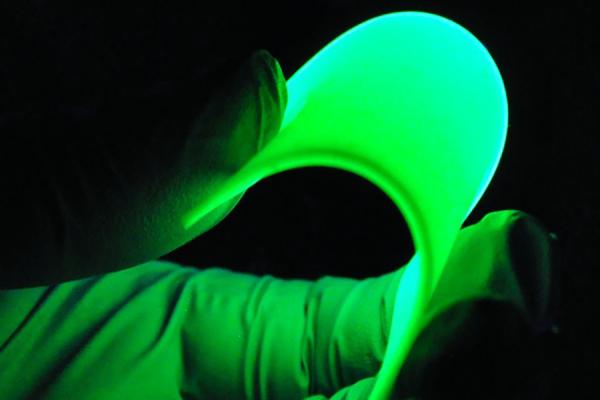
A researcher holds a flexible X-ray scintillator developed by Professor Biwu Ma and his research team. The team has developed a new material that could be used to make flexible X-ray detectors that are less harmful to the environment and cost less than existing technologies. Photo courtesy of Biwu Ma / Florida State University
September 3, 2020 — Florida State University researchers have developed a new material that could be used to make flexible X-ray detectors that are less harmful to the environment and cost less than existing technologies.
The team led by Biwu Ma, Ph.D., a professor in the Department of Chemistry and Biochemistry, created X-ray scintillators that use an environmentally friendly material. Their research was published in the journal Nature Communications.
“Developing low-cost scintillation materials that can be easily manufactured and that perform well remains a great challenge,” Ma said. “This work paves the way for exploring new approaches to create these important devices.”
X-ray scintillators convert the radiation of an X-ray into visible light, and they are a common type of X-ray detector. When you visit the dentist or the airport, scintillators are used to take images of your teeth or scan your luggage.
Various materials have been used to make X-ray scintillators, but they can be difficult or expensive to manufacture. Some recent developments use compounds that include lead, but the toxicity of lead could be a concern.
Ma’s team found a different solution. They used the compound organic manganese halide to create scintillators that don’t use lead or heavy metals. The compound can be used to make a powder that performs very well for imaging and can be combined with a polymer to create a flexible composite that can be used as a scintillator. That flexibility broadens the potential use of this technology.
“Researchers have made scintillators with a variety of compounds, but this technology offers something that combines low cost with high performance and environmentally friendly materials,” Ma said. “When you also consider the ability to make flexible scintillators, it’s a promising avenue to explore.”
Ma recently received a GAP Commercialization Investment Program grant from the FSU Office of the Vice President for Research to develop this technology. The grants help faculty members turn their research into possible commercial products.
Other Florida State researchers who contributed to this paper include first author Liang-jin Xu, X-ray crystallography facility manager Xinsong Lin, postdoctoral researcher Qingquan He and doctoral researcher Michael Worku.
This work was funded by the Air Force Office of Scientific Research as well as the National Science Foundation and the FSU Office of Research.

 October 08, 2026