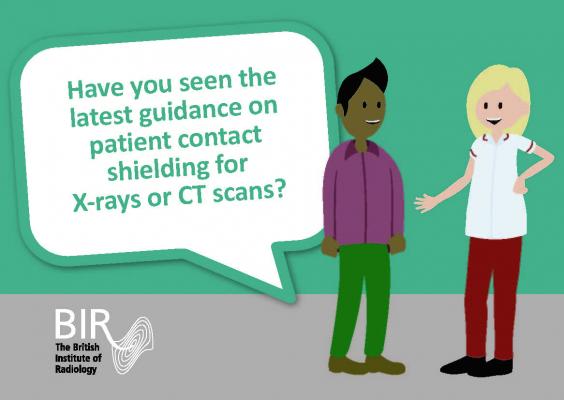
March 13, 2020 — The British Institute of Radiology (BIR) and a working party of U.K. radiological professional bodies and agencies have published evidence-based guidance that shows patient contact shielding (such as aprons, thyroid or gonad shields) provides minimal or no benefit. It concludes that there are other areas of radiation protection which are more effective in optimizing radiation exposure such as education and training, good radiographic technique and use of technology.
When the use of protective aprons or shields for patients was first introduced, the imaging equipment gave out more radiation than machines today and it was thought that contact shielding could only provide a benefit to the patient.
In the past, a certain level of radiation dose was inevitable in order to get a good image, but technical advances in medical imaging equipment means that machines can now be adjusted to minimize radiation and still achieve a clear image for diagnosis. It has also become apparent that protective aprons or ‘contact shielding’ can sometimes cover up the part of the body which needs to be imaged, or the shielding can move during an examination or interfere with the imaging equipment. This might mean having a repeat X-ray, which could give additional radiation to the patient. This has led to inconsistencies in the use of contact shielding across the U.K..
Staff are well-trained in positioning the patient so that radiation to the body is minimised; ensuring that the patient is only exposed to enough radiation to achieve a good image.
They are also proficient in making the best use of technology to keep radiation dose as low as possible.
The evidence-based guidance was written by a collaborative working party including representatives from the British Institute of Radiology, Institute of Physics and Engineering in Medicine, Public Health England, the Royal College of Radiologists, Society and College of Radiographers and Society for Radiological Protection.
This guidance is about contact shielding for patients only. Staff working in the X-ray, CT room and in interventional radiology will still continue to wear aprons and shields because they are working in this area all the time and have greater exposure to radiation so they have the risk without the benefit.
Peter Hiles, chair of the BIR working party said “This guidance offers clarity to both patients and professionals and hopefully will lead to a consistent approach in the future as this provides scientific evidence for change. However, it will require a major cultural change in outlook regarding radiation safety and practice in this area."
To read the guidance and for FAQs: www.bir.org.uk/patientshielding
 October 07, 2026