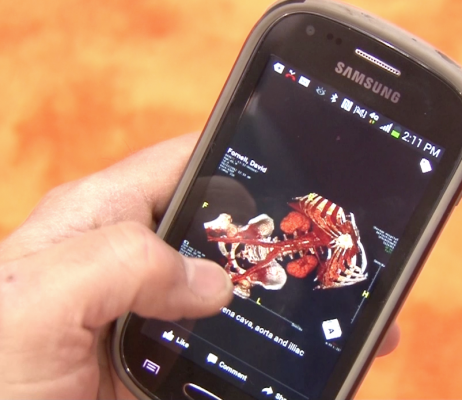
December 11, 2019 — Despite the numerous benefits associated with patients accessing their medical records, a new study by a Portland State University professor found only 10 percent of patients utilize the resource.
Researchers expected to find inequities in use and access — in theory driven by existing digital disparities, those who don't use English as a first-language or communities without access to reliable internet services. However, they were surprised to find that use is unilaterally low. More than 95 percent of patients recently discharged from a hospital had access to electronic records. But use was disproportionately low across all hospital types.
"This means that there's something there that hospitals could be doing on their own to get more people to use the record," said Sunny Lin, assistant professor in the OHSU-PSU School of Public Health, who led the study. University of California San Francisco Associate Professors Julia Adler-Milstein, Courtney R. Lyles and Urmimala Sarkar also contributed to this research.
Hospitals are financially incentivized by the federal government through the Promoting Interoperability Program to offer patients electronic records -- but only one patient needs to access those records to qualify for continued funding. "They're not required to actively recruit people to use it," Lin said.
Patient use, however, has its benefits. Lin said studies show patient engagement affects their quality of care and outcomes.
"They're finding patients who are more engaged in their own care, especially after a hospitalization, are able to communicate better with their providers and they have a better idea about what's going on," she said. "They then have better follow up care and as a consequence — lower readmission."
This paper, Lin said, also speaks to the larger dynamic shift that's occurring within hospital systems. Many systems are exploring supplemental care options to improve patients' outcomes, including food security, housing and drug addiction assistance programming outside the hospital. Offering additional services goes beyond just providing care -- focusing on patient engagement is one facet of the larger picture.
"We're trying to push people to think about if we can do more as a hospital," Lin said. "Should we set that bar a bit higher?"
A recent study found the doctor-patient relationship determined whether or not the patient would actually use the record. Lin said although doctors are expected to do more and more, patient engagement is still key to success. Trusting a provider will further encourage patients to access their records.
"It's a shared responsibility to get people to use their records," she added. "It's about patients actually taking that step but it's also about hospitals making it easy to access."
For more information: www.pdx.edu

 October 01, 2026