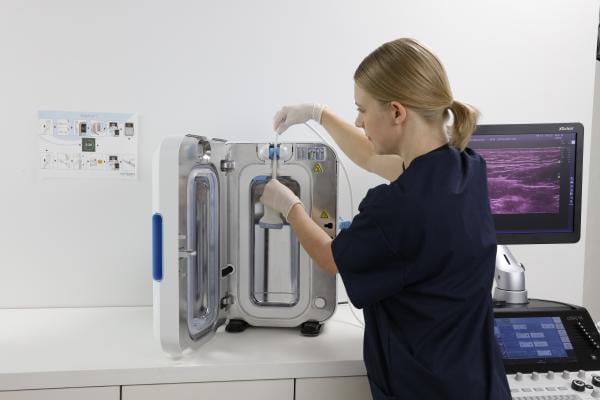
October 17, 2018 — Nanosonics announced the commercial availability of its Trophon2 high level disinfection (HLD) system for ultrasound probe decontamination in the United States and Canada. The new device, which prevents exposure to hazardous chemicals, offers medical professionals a smart solution that helps ensure compliance with the latest guidelines for reprocessing of surface and endocavity ultrasound probes. The system is also equipped with an automatic traceability solution that creates audit-ready digital records of each HLD cycle with the option for information technology (IT) integration.
Initial feedback from customers in North America implementing Trophon2 as standard-of-care for HLD probe reprocessing has been positive, according to Nanosonics. The company showcased the new device and its suite of HLD products at the 2018 Society of Diagnostic Medical Sonography (SDMS) annual conference, Oct. 4-7 in Orlando, Fla.
Ultrasound imaging is one of the fastest growing medical procedures due in part to its expanded use across multiple medical specialties.1 While ultrasound is safe, there are risks of cross-contamination if probe reprocessing is not performed correctly. Global guidelines now recommend HLD between patients for ultrasound probes used in semi-critical procedures, including intracavity procedures, and for surface ultrasound procedures on non-intact or broken skin, to effectively reduce the risk of infection for patients and staff.
Yet, adhering to HLD best practices is not routinely implemented on several ultrasound procedures that require it. This was recently highlighted by a survey published in the American Journal of Infection Control, showing that there are a large number of procedures where HLD is not being performed between patients. Improper infection prevention practice associated with ultrasound probe use has been linked to increased infection risk, outbreaks and death.2
According to Raleigh White, CRA, RT(R), MA, director of imaging services at Hutchinson Regional Medical Center in Kansas, “Since implementing trophon technology as our infection prevention standard of care for ultrasound probe reprocessing, we are significantly more effective at high-level disinfection throughout our facility. Even though ultrasound is one of the safest and most widely-used imaging modalities today, following best practices and eliminating the risk of infection transmission between patients was often time-consuming and required the use of toxic chemicals as well as the need for a special ventilation system within our facility.
“With trophon HLD, the transducer decontamination process is quick, simple and doesn’t require hazardous chemicals,” continued White. “Equally as important, the confidence amongst our sonographers in their ability to eliminate the risks of infection transmission has been raised exponentially since adopting trophon. During my career, I’ve had several Joint Commission surveyors observe the trophon HLD process and I have been told repeatedly that it is the gold standard for maintaining patient and user safety.”
The automated Trophon2 generates a sonically activated, supercharged hydrogen peroxide (H2O2) mist that kills drug-resistant bacteria, fungi and viruses. The device is validated for use with over 1,000 different probes across all major ultrasound companies, and offers an effective traceability solution with AcuTrace, capturing required information to create audit-ready digital disinfection records. The platform also offers the option for hospitals to integrate trophon2 into their IT systems with AcuTrace Plus, thereby centrally storing disinfection records for easy access by the entire IT system and linking information directly to patients’ electronic medical records.
For more information: www.nanosonics.us
References
- https://www.healthimaging.com/topics/healthcare-economics-policy/8-glob…
- GOV.UK Medical Safety Alert; Reusable transesophageal echocardiography, transvaginal and transrectal ultrasound probes (transducer) – failure to appropriately decontaminate. (https://www.gov.uk/drug-device-alerts/medical-device-alert-reusable-tra…)

 October 07, 2026