Enterprise-wide peer learning to improve quality.
Achieving quality in healthcare demands a multifaceted approach that includes technology, education and professional dedication. Alberta Health Services (AHS) is using Change Healthcare’s solution for automated, anonymous peer review as a driving force for improved quality.
The program has not only provided day-to-day practice, but has in some cases had a lifesaving impact on individual patients.
When an anonymous review discovered a colon cancer that was missed on a recent study, AHS was able to alert the radiologist, who quickly contacted the attending physician. Because the solution is configured to select recently performed studies for peer review, the care team could adjust the patient’s care pathway.
While few discrepancies are that dramatic, it is a good example of the difference in care that the peer review program brings to Alberta.
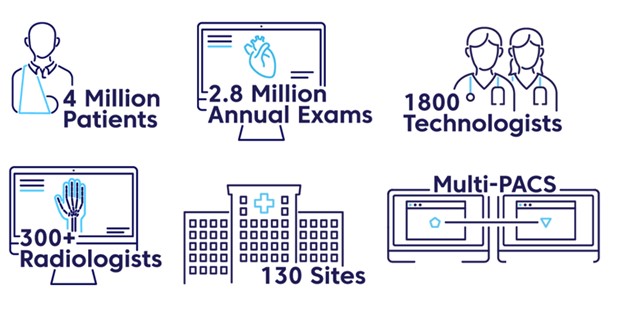
As Canada’s largest provincial health system, AHS serves more than 4 million people. The system includes 134 imaging facilities that range from high-end acute care trauma centers to small rural community hospitals and health centers. Nearly 3 million annual exams are performed by 1,800 technologists and interpreted by over 300 radiologists who work in 16 different professional organizations and groups.
Quality has always been a high priority for the province, but in 2011 a series of events highlighted the need for a more systematic approach.
AHS officials discovered that in one rural community, several CT studies had been misinterpreted, raising questions about the care provided to patients. Out of that incident, the provincial Health Minister ordered a thorough examination of quality assurance practices for performing and reading all radiological patient studies. These discoveries gave a boost to AHS’ ongoing efforts to enhance quality and drive better patient care.
The province embarked on a program where the primary goal was the reduction of errors in diagnostic imaging, with the end goal of improving patient outcomes. “Quality is the only driving force behind our program,” said Marlene Stodgell O’Grady, AHS director of quality, education and safety. “We constantly ask ourselves how we can ensure that the public is confident that we’re monitoring the quality of the service provided in our facilities and ensuring that we are providing the highest standard of care.”
Achieving buy-in for a review process can be challenging, but AHS brought teams of radiologists and technologists together early in the process so they could design a program that would meet their needs and fit seamlessly into their workflows.
The next step was identifying a solution that provided a high level of functionality and integration, and also delivered the level of customization that was needed by this project.
At the heart of this quality improvement program is a structured process that ensures studies are anonymized before review by outside radiologists. Each study is stripped of identifying data such as patient name, radiologist and location.
“When we knew what we wanted, we went and found the right solution,” said Stodgell O’Grady. “One of the key components in our program is that need to have all the reviews performed anonymously. We have multiple radiology groups across the province. We really felt that to maintain an educational focus and solicit unbiased reviews, the process had to be anonymous.”
Following a comprehensive search, AHS selected Change Healthcare’s Workflow Intelligence. It was the only product that could provide true anonymization of studies, according to Stodgell O’Grady.
Scans are randomly assigned to radiologists throughout the province for a second look. With many different facilities and groups scattered over a wide geographical area, the solution also had to seamlessly connect multiple PACS and RIS.
“Our peer review program has to span a large area and connect to multiple systems to make it effective,” she explained.
The system sends the anonymized study to a randomly selected radiologist. When radiologists login the images are waiting for them. They can immediately review the scan and then grade it using a modified American College of Radiology scale.
The goal of the quality assurance program is not punitive, but aimed at improving performance by radiologists and technologists and the overall quality of care.
“Our peer review program is education-focused because we needed to make sure there was no mechanism for anyone to utilize the system to further their own financial or business interests,” said Stodgell O’Grady. The successful implementation of the program has been a collaborative effort and a significant change in practice for all involved. The program was initially implemented for general imaging and CT studies. It has since expanded to include MRI, and will expand even further next year to include nuclear medicine and ultrasound.
Since the program was implemented in October 2015, more than 90,000 technologist reviews and 26,000 radiologist reviews have been performed. Thanks to these reviews nearly 700 clinically significant discrepancies have been identified.
In addition to finding discrepancies quickly and improving patient outcomes, the system has driven higher levels of performance by radiologists and technologists alike. The kinds of ordinary mistakes that are easily identified have been largely eliminated, allowing the system to focus on less common and hard-to-identify errors.
“So not only have we given technologists and radiologists individual feedback on their performance, but we’ve taken the information that comes out of the system and identified trends across the province,” explained Stodgell O’Grady. “The program has taken those trends and collated data and identified areas where there are consistent challenges across the province, and we have created learning and educational materials.”
By identifying trends within the health system, the program can achieve results that reach beyond individual physicians and staff. For example, data drawn from the peer review system identified wider-spread issues with scans of skulls and knees for trauma.
“We took that information and our quality assurance specialists created learning modules,” said Stodgell O’Grady. “They worked with employees and helped them to learn and improve the quality of these scans.”
AHS also developed auditing and education programs to improve practices and protocols for computed tomography angiography for stroke. This training has allowed staff to improve practices for performing scans which results in better quality images.
“So not only are the quality of the images improving but the number of repeats being done are decreasing and as a direct result of that our patients are getting less radiation,” she explained.
Case study supplied by Change Healthcare.

 September 21, 2026