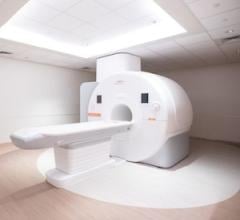
At RSNA 2016, Siemens Healthineers unveiled its groundbreaking Compressed Sensing technology, which overcomes a major limitation of magnetic resonance imaging (MRI): long acquisition times. With Compressed Sensing, MRI scans can be shortened dramatically. For example, cardiac cine imaging with Compressed Sensing can be performed in 16 seconds rather than the traditional four minutes, thanks to an innovative algorithm that reduces the amount of data required.2
Only Key Data Points Required
Thanks to Compressed Sensing, fewer data points are needed to provide MR images of diagnostic quality. Iterative reconstruction enables the reconstruction of high-resolution, high-quality images with no information loss. Additionally, the efficient inline reconstruction algorithm of Compressed Sensing enables a high degree of clinical throughput. The acquired data is calculated directly at the MRI scanner, requiring no export or external processing of that data.
In cardiac imaging, Compressed Sensing Cardiac Cine takes full advantage of this algorithm. Rather than hold their breath 10 to 14 times, which can take four minutes due to regenerative scan breaks, patients can now breathe freely, and the acquisition time is roughly 16 seconds. Accurate assessment of additional quantitative information such as ejection fraction requires only one breath hold. Motion artifacts caused by breathing and heartbeats are effectively avoided, which benefits older and critically ill patients who cannot hold their breath.
MRI for Patients With Cardiac Arrhythmias
The speed of Compressed Sensing Cardiac Cine makes cardiac MRI accessible to entirely new patient groups, including those with cardiac arrhythmias. The software is currently 510(k) pending. In the past, cardiac MRI scans were not an option for these patients due to the images’ low diagnostic quality. But thanks to the adaptive triggering of Compressed Sensing, the entire cardiac cycle – including diagnostic information regarding the late diastolic phase – can be recorded in real time with a single breath-hold. Compressed Sensing Cardiac Cine also offers excellent visualization and quantification of the left ventricle function, according to scientific studies.
The Compressed Sensing algorithm developed by Siemens Healthineers won acclaim from the International Society for Magnetic Resonance in Medicine (ISMRM) at the 2014 Competition for Dynamic Imaging. Working with research partners, Siemens Healthineers further developed the algorithm and transformed it into a product. For years, selected customers worldwide have been using a work-in-progress (WIP) imaging package for application in research. Compressed Sensing technology has been tried and tested in multiple clinical settings, with numerous studies attesting to its advantages.
For more information: www.siemens.com/healthineers
Reference:
1. Kido, et al. Journal of Cardiovascular Magnetic Resonance (2016).

 October 07, 2026