June 13, 2016 — An emerging molecular imaging technique may provide a way to break the perpetual cycle of abuse of alcoholism. It could signal patients’ heightened risk and lead to targeted drug treatments that reduce the compulsion to drink, said researchers presenting at the 2016 Annual Meeting of the Society of Nuclear Medicine and Molecular Imaging (SNMMI), June 11-15 in San Diego.
According to 2016 statistics from the National Institute on Alcohol Abuse and Alcoholism (NIAAA), almost 7 percent of adults over the age of 18 had a drinking disorder in 2014. Alcohol-related deaths were deemed the fourth leading cause of preventable death, accounting for nearly 88,000 deaths in the same year.
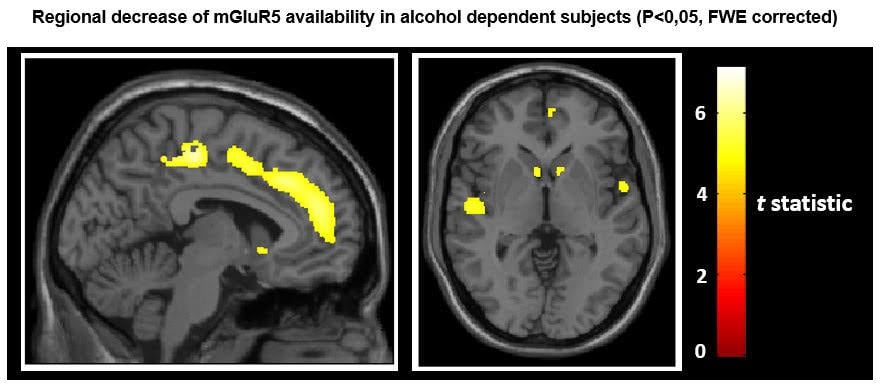
Images of the brain lit up like fireworks as people experience pleasure and reward are a familiar sight, but sometimes the reward needs to be taken away. In this groundbreaking study, researchers imaged the brains of recently recovering alcoholics and found an inverse and compensatory adaptation in a particular receptor involved in memory, learning, and the sensations of pain and anxiety. This receptor, called metabotropic glutamate receptor subtype 5 (mGluR5), is found throughout the central and peripheral nervous systems but, in certain areas of the brain, it is implicated in intense cravings and addictive relapse. It seems that the brains of recovering alcoholics have adapted to the enduring state of chemical dependency by significantly hindering mGluR5 receptors in the cerebral cortex and limbic system, thereby reducing cravings.
“Alcohol addiction is a complex, chronic brain disorder associated with enormous physical, social and financial consequences worldwide, and yet current therapies remain unsatisfactory,” said senior author Koen Van Laere, M.D., Ph.D., University Hospital Gasthuisberg, Leuven, Belgium. “Our team was able to investigate, for the first time, these marked changes in the brain circuitry of alcohol-dependent humans.”
Understanding this relationship between mGluR5 and the compulsion to drink could be the key to long-term sobriety by allowing doctors to predict if patients are liable to relapse. Additionally, this research could lead to new targeted drugs that limit receptor activity in patients who lack this neuro-adaptation or are otherwise at increased risk of returning to alcohol abuse.
For this study, researchers combined positron emission tomography (PET) with computed tomography (CT). The PET imaging agent F-18 FPEB, which binds with mGluR5 receptors, was administered to 16 recently sober subjects, ranging from 32 to 57 years of age, and 32 healthy controls with no alcoholism in their backgrounds. Participants then underwent quantitative PET/CT imaging that measured respective mGluR5 receptor binding. Subjects also provided a drinking history and underwent hair analysis to evaluate their drinking pattern. Quantitative PET/CT results showed significantly reduced mGluR5 availability in the bilateral cingulate, caudate and insular cortex of the limbic systems in alcohol-dependent subjects regardless of age, gender or smoking status when compared to healthy controls.
“Collectively, these findings strongly substantiate the development of mGluR5-targeted therapies that heal or protect against the dysfunctional brain circuitry that characterizes alcohol addiction,” said Gil Leurquin-Sterk, M.D., first author of the study.
For more information: www.snmmi.org
 October 06, 2026