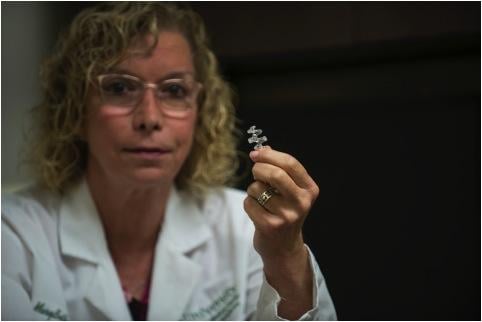
Mary Beth Tomaselli, M.D., shows the BioZorb 3-D bioabsorbable marker, a small coil inserted into the breast by the surgeon when a breast cancer tumor is removed. The device holds six tiny clips arranged in a three-dimensional array. This 3D array remains over time, while the coil holding the clips dissolves. "This is a great innovation," said Dr. Tomaselli, which has been "very well received by radiation oncologists, and it's a benefit to the patients in getting more accurate radiation therapy and a more satisfying cosmetic result." Photo courtesy of Business Wire.
August 5, 2015 — A Coral Springs, Florida, surgeon is among the first in the state to adopt an innovative new device that improves the treatment of breast cancer.
Mary Beth Tomaselli, M.D., has helped pioneer use of the BioZorb tissue marker when performing surgery to remove the cancer and preserve the breast.
BioZorb is a small coil, inserted into the breast by the surgeon at the time of tumor removal, which holds six tiny clips arranged in a three-dimensional array. This 3-D array remains over time, while the coil holding the clips dissolves.
"When we surgically remove the cancer, we want to mark the exact area where the tumor was located,” said Tomaselli, medical director and co-founder of the Comprehensive Breast Center of Coral Springs. “We place this new marker precisely at the site of the tumor, oriented the same way the tumor was oriented. Then the radiation oncologist can focus the beam specifically where the tumor was."
Breast cancer can be treated by mastectomy (breast removal) or by lumpectomy. With lumpectomy, a small amount of tissue containing the tumor is removed. In addition to the surgery, it is important to add radiation treatment to “clean up” any microscopic cancer cells that might remain behind in the breast.
The addition of radiation allows surgeons to safely conserve the breast tissue, while decreasing the chances of cancer recurring in the same location. Prior to the development of the surgical marker, radiation treatments usually had to be directed at a larger portion of the breast tissue.
“This device allows us to target a smaller volume of tissue,” said Eduardo Fernandez, M.D., Ph.D., a radiation oncologist who treats many of Tomaselli’s patients after surgery. “It makes it easier for us to better protect women from unnecessary radiation exposure, and to use newer image-guided techniques.” Fernandez is a radiation oncologist and senior vice president for medical affairs at 21st Century Oncology.
Among the dozens of local patients who have benefited from the device is Monica Severn, 59. An Air Force veteran and certified X-ray technician, she directs the CareSpot Express Healthcare urgent care facility in Pembroke Pines.
Severn detected a small lump on her right breast last fall, which a biopsy determined was early-stage breast cancer. Her primary care doctor directed her to Tomaselli, who performed a lumpectomy in October. Fernandez oversaw the radiation therapy.
"He assured me they would be able to direct the radiation right where the cancer was," Severn recalled. "It was wonderful to have that pinpoint accuracy. I knew the radiation was important because you could have a few cancer cells left behind after the surgery. And you need that kind of accuracy so you don’t radiate healthy tissues.”
Tomaselli now uses the BioZorb device for virtually all lumpectomy surgeries. She noted that it’s especially valuable to help achieve a better cosmetic outcome when newer “oncoplastic” techniques are employed to reconstruct the tissue.
“This is a great innovation by someone who clearly thought this out from a surgical and patient standpoint,” she said. “It’s been very well received by the radiation oncologists, and it’s a benefit to the patients in getting more accurate radiation therapy and a more satisfying cosmetic result.”
For more information: www.focalrx.com
 October 09, 2026