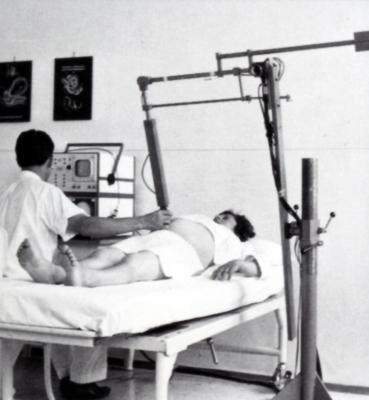
Combison compound scanner

Do you have "vintage" industry technology photos? If so, we'd love to hear from you, and the older the better! We are looking for "vintage" images that we can use for an industry timeline in ITN’s November/December issue, where we will be recognizing RSNA's 100th anniversary, and talking about the evolution/revolution of the industry. If you are willing to share, please contact ITN editorial director Melinda Taschetta-Millane at [email protected]. You will need to include a caption describing the image and also a photo credit.


Additional Content

Technology | Digital Radiography (DR)

The ddRCruze is Swissray’s answer to portable imaging flexibility. Compact, fully motorized and mobile this DR system can be easily operated with one hand. Bedside or any other area of the hospital, it delivers superb image quality, seamlessly connects to hospital networks and delivers maximum workflow efficiency. We asked technologists to help us design the perfect mobile system. With their feedback we developed a system with features to make the work day “Cruze“ by.

Time October 20, 2016
arrow
Technology

Biodex showcased its latest line of medical imaging tables and Clear-Lead Shielding at RSNA.

Time November 11, 2015
arrow
Feature | Lynn Tangorra

A new era of telehealth has arrived. According to HIMSS Analytics 3rd Annual Mobile Survey, 83 percent of physicians use mobile technology to provide care. Because doctors are so mobile, patient information has to be mobile as well. The goal of telehealth is to eliminate geographic constraints and deliver quality patient care at any time, in any location.1 Many healthcare providers have shown an increasing interest in telehealth because of the benefits it can provide, among them, greater access to patient data and images, lower costs and higher quality of care. Offerings of telehealth include consumer online access to providers for diagnosis and treatment of common ailments, real-time video-based virtual consults between providers and patients, in-home monitoring of chronically ill patients, and primary care physicians’ access to specialists for consultation and diagnosis.

Time January 30, 2015
arrow
Feature | Dave Fornell

Imaging is pivotal for detection, staging and evaluation of tumor response to treatment. It is instrumental in determining which treatment is best suited to a patient and may be used to help guide surgery and radiation therapy. With chemotherapy, follow-up imaging exams are used to track tumor response and determine if different drugs should be used.

Time January 30, 2015
arrow
Feature | Dave Fornell

Angiographic imaging system vendors have developed several new technologies to address emerging cath lab trends, including the need to reduce radiation dose, improve image quality and enable advanced procedural image guidance. All three of these points have become increasingly important as more complex procedures are attempted in interventional labs and hybrid ORs. These procedures include embolic coiling, neuro-interventions, thrombectomy, aortic repair, transcatheter aortic valve replacement (TAVR), mitral clip valve repairs, left atrial appendage (LAA) occlusions, atrial and ventricular septal defect closures, and new interventions for both electrophysiology (EP) and heart failure.

Time January 30, 2015
arrow
Subscribe Now