February 28, 2014 — HIMSS Analytics published the results of the third annual HIMSS Analytics Mobile Survey at its annual conference in Orland, Fla. The survey examines use of mobile devices in provider patient care improvement initiatives. For the first time this year, the survey questions were modified to closely align with the six areas of the mHIMSS Roadmap, a strategic framework for providers to implement mobile and wireless technologies.
The roadmap sections encompass key areas of consideration healthcare organizations should focus on when developing and implementing a mobile strategy within a healthcare organization: New Care Models, Technology, ROI/Payment, Legal and Policy, Standards and Interoperability, and Privacy and Security.
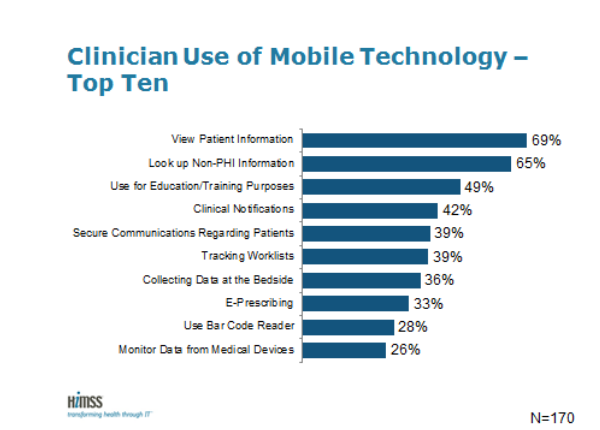
The survey findings offer examples of the progress made and hurdles that providers face when integrating mobile technologies into their facilities to improve patient care. Respondents indicated that the top benefit to having mobile technologies in their facilities was increased access to patient information and the ability to view data from a remote location. Funding limitations topped the list for barriers. Many providers are also still early in their adoption and implementation of mobile technology. For example, 69 percent use a mobile device to view patient information while only a third (36 percent) use mobile technologies to collect data at the bedside.
Key findings from respondents that were examined through the roadmap sections include:
Legal and Policy
- 59 percent have a mobile technology plan
- 29 percent are developing a mobile technology plan
- HIPAA is the federal legislation that is most likely to impact organizational mHealth environment
Privacy and Security
- 95 percent use at least one security tool to secure data on mobile devices
- Passwords are the most widespread security device in place
New Care Models
- Clinicians are most likely to use technology to support patient care by either looking up patient information or looking up non-personal health information
- For the second consecutive year, pharmacy management topped providers’ lists as the most likely use of mobile technologies, including medication reminders or medication reconciliation
Technology
- App development is mostly handled by vendors or third party vendors
- More than half of provider respondents indicate they would expand their use of apps in the future
- One-third of respondents offer apps for patient/consumer use, up from 14 percent a year ago
- 62 percent indicated that they offer patients access to at least one of the mobile tools identified in the research, including patient portals, telehealth services and remote monitoring devices
ROI and Payment
- Just half formally measure ROI related to their mobile technology investments
- A mere third of respondents evaluate the total cost of ownership as it relates to their mobile strategy
Standards and Interoperability
- Only 22 percent indicated that three-quarters of the data captured by mobile devices was integrated into the organization’s electronic medical records (EMR)
- Most respondents can access data from clinical systems via mobile devices and clinicians are the most like to do this via Internet access using a VPN
- More than half of the respondents indicate that alerts/notifications fromremote monitoring devices are delivered via an EMR/clinical system alert
Mobile Device Policy Adoption
Respondents with a policy in place were asked to identify what items were covered by that policy. Respondents continue to indicate that device security is a key component of their organizations policies. More specifically, 84 percent of respondents noted that their policy outlines the process for managing lost or stolen devices and another 80 percent indicated that their organization addresses the means by which devices should be secured. Means by which devices were secured was the most frequently identified issue in both 2011 and 2012. Process for managing lost or stolen devices was added to the study for the first time in the 2013 study.
New Care Models
Clinicians are most likely to use mobile technology to look up patient information or reference information like clinical guidelines. Respondents were also most likely to indicate that their organization leveraged mobile technology for pharmacy management.
Respondents were also asked to identify the purposes for which clinicians at their organizations use mobile technology. Because this question last year referred specifically to the use of apps, no year-over-year comparison will be provided. Respondents were most likely (69 percent) to indicate that they used mobile technology to view patient information such as a lab result or digital image. Approximately two-thirds (65 percent) also indicated that they used mbile technology to look up non-PHI information, such as clinical guidelines.
Respondents were less likely to report that clinicians use mobile technology to facilitate remote patient monitoring. This was identified by 20 percent of respondents.
Additionally, respondents were asked to identify the extent to which organizations leveraged technology to impact patient care. Using a scale of one to seven, where one is no benefit and seven is high degree of benefit, respondents were most likely to indicate that mobile technology was leveraged for pharmacy management, which includes tasks such as medication reminders and medication reconciliation. This item received an average score of 3.73. This item also received the highest average score in 2012, at 4.1.
The survey reflects the responses of 170 healthcare IT and clinical personnel.
For more information: www.himssanalytics.org

 September 09, 2026