April 3, 2012 — New guidelines for CT-guided biopsies of lung nodules significantly reduce radiation exposure, allowing individuals the benefit of the procedure, which may cut down on overall lung cancer deaths. This research was presented at the Society of Interventional Radiology's (SIR) 37th Annual Scientific Meeting in San Francisco.
"The published early results of a trial using computed tomography (CT) to detect lung nodules demonstrated that screening with low-dose CT reduced mortality from lung cancer by 20 percent compared to screening with chest X-rays alone," said Jeremy Collins, M.D., assistant professor of radiology at Northwestern University in Chicago. "Statistically, many people who undergo screening will have nodules detected with CT and a biopsy may be recommended. We want to minimize the side effects of the biopsy procedure."
While there is debate about the actual risk of cumulative exposure from the types of medical imaging that emit radiation, interventional radiologists are trying to curb patient dose, and CT has been gaining recognition as the most effective imaging technique for lung nodules since it is more sensitive than chest X-rays and other imaging tests.
"Lung nodules are clearly imaged using CT because of the high contrast between normal air-containing lung tissue and higher-density lung nodules. CT technologies have come a long way in offering new tools that reduce the per-procedure radiation dose," said Collins.
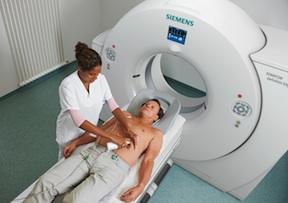
The research focuses on a new set of CT imaging parameters to further reduce radiation exposure while maintaining image quality. The new protocol downshifts the amount of energy the CT scanner uses to produce images and moderates the current of the X-ray tube to put out a smaller dose during examination.
"All image studies using X-ray technology are going to be associated with a small amount of finite radiation exposure," said Collins. "Although the jury is still out to some degree, there is general consensus in the community that the radiation dose risk is both linear and additive. Any place where we can reduce the incremental dose for each imaging study is very important because the overall exposure over time can be substantial.”
For this study, researchers implemented the new CT imaging protocol for lung-nodule biopsy and then reviewed data from 100 people, half of whom underwent CT-guided biopsies prior to the new protocol and half after the protocol went into effect. The low dose protocol led to a dramatic 66 percent drop in radiation dose, and image quality was maintained for all of the CT-guided biopsies.
"We found that simple modifications to the CT technique used for guidance to perform lung biopsies resulted in a significant dose reduction to individuals treated," said Collins. "This was possible while maintaining appropriate image quality for interventional radiologists performing biopsy, and fortunately the modification to the scanner technique is simple and can be applied to any existing CT scanner system.”
"The new protocol can be adopted immediately to reduce exposure, but interventional radiologists will still need to evaluate each person on a case-by-case basis, especially smaller people or those who have anatomy that is more difficult to image. The dose can be reduced even further for children, but more studies need to be done to tailor the protocol," he added.
For more information: www.SIRweb.org.

 August 21, 2026