March 12, 2012 — A new study shows that the use of gadobenate dimeglumine, the highest relaxivity gadolinium-based contrast agent (GBCA) available for central nervous system (CNS) magnetic resonance imaging (MRI), over a high concentration MRI contrast agent may improve clinicians’ ability to visualize lesions of the brain.
Results of the MERIT Study, the latest in a series of intraindividual studies directly comparing MRI contrast agents within the same test subjects, are published online in the American Journal of Neuroradiology. The findings suggest that the higher relaxivity agent, gadobenate dimeglumine may be linked to greater signal intensity, better contrast enhancement, and better lesion conspicuity in MRI of the brain. The authors also concluded that high concentration does not provide the same benefit as high relaxivity in improving diagnostic performance.
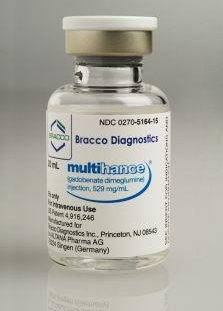
In this large multicenter, randomized, double-blind crossover intraindividual study, researchers compared MultiHance to Gadavist. They concluded that MultiHance provided significantly greater morphologic information, lesion enhancement and contrast enhancement when compared to Gadavist, at equivalent doses for MRI of the brain. They also found no relevant benefit for the more highly concentrated Gadavist in terms of lesion conspicuity, visualization or sensitivity for detection.
The study’s aim was to compare the two agents using a carefully controlled multicenter, double-blind, randomized, intraindividual crossover study design, in which each of the 114 patients received 0.1 mmol/kg doses of both agents in two identical MR imaging examinations. This study is of particular interest because Gadavist differs from other approved GBCAs in that it is formulated at double concentration (twice the concentration of gadolinium is present per unit volume). As of 2011, there have been no studies performed to compare the more highly concentrated Gadavist with the higher relaxivity agent MultiHance for MRI imaging of brain tumors.
The authors stated “two conclusions can be drawn from our findings. Firstly, it is clear that contrast agent concentration in the vial has no effect on imaging performance since injection of the more highly concentrated (1 mol/L) GBCA at 0.1 mmol/kg bodyweight provides no appreciable clinical advantage relative to published findings for conventional GBCAs at standard concentration (0.5 mol/L) when compared with gadobenate dimeglumine at an identical dose of 0.1 mmol/kg bodyweight. The lack of any appreciable benefit with gadobutrol can be ascribed to the fact that the SI during the interstitial phase (i.e. at post-injection acquisition times of 3-10 minutes as typically performed for brain tumor imaging) depends solely on the total amount of gadolinium in the lesion (i.e., the total number of gadolinium molecules) and its relaxivity rather than on the gadolinium solution concentration. Secondly, it is clear that higher r1 relaxivity is instrumental in improving diagnostic performance relative to that achievable with conventional GBCAs at equivalent dose.”
These conclusions support a literature review and simulation model, published last year, which concluded that most clinical trials to date have not found a benefit for higher concentration MRI agents. Instead, it is the dose and relaxivity of a compound, not the concentration, which significantly influence signal intensity in MRI.
Statistically significant (p<0.0001; all readers, all comparisons) results in favor of MultiHance were demonstrated for each individual diagnostic information endpoint used in the study, as well as for quantitative parameters linked to the contrast enhancement obtained with the two agents (contrast-to-noise ratio, [CNR] and lesion to brain ratio [LBR]), when a preference was expressed by the three independent blinded readers.
“The key importance of this study is that its results were similar to prior clinical investigations of this kind comparing Magnevist (gadopentetate dimeglumine) to MultiHance, and Omniscan (gadodiamide) to MultiHance, so you now have three studies of this design demonstrating similar findings for contrast agents used for MRI,” said Alberto Spinazzi, senior vice president of worldwide medical and regulatory affairs at Bracco Diagnostics Inc. “These results are consistent in showing some clear advantages relative to performance associated with using the highest relaxivity agent for CNS MRI, MultiHance, versus other GBCAs.”
The two contrast injections were performed in a blinded and fully randomized manner with an interval of two to fourteen days between administrations, to avoid any carryover effects. Half of the patients received MultiHance for their first exam and the other half received Gadavist first. Imaging parameters and post-dose acquisition times were kept identical for the two exams of each patient. To maintain the study blind, each agent was administered by an independent drug-dispensing person. Images were evaluated by three independent and experienced neuroradiologists, who were unaffiliated with the enrollment centers, and fully blinded to any clinical information about the patients and the agents used in the two exams. Image assessments were made in terms of diagnostic information (global diagnostic preference, lesion border delineation, definition of disease extent, visualization of lesion internal morphology, lesion contrast enhancement) and quantitative parameters (signal intensity [SI], CNR and LBR).
The findings of all 3 readers in global diagnostic preference were highly significant (p<0.0001) between the 2 agents. Readers 1, 2 and 3 reported global preference for MultiHance in 40.7, 47.4, and 43 percent of patients compared with 5.3, 6.1 and 6.1 percent of patients for Gadavist, respectively. Similar highly significant preference was demonstrated for each individual diagnostic endpoint. Reader preference was based on superior contrast enhancement and better delineation of lesion and/or internal lesion structure.
“Bracco Diagnostics believes that MultiHance may improve the visualization of CNS disorders in MRI, and that relaxivity, not concentration, is what matters when it comes to improved image quality, noted Carlo Medici, president and CEO of Bracco Diagnostics Inc. “We are pleased that this large-scale clinical investigation supported this. This concurrence of clinical evidence is an important criterion for clinicians when making evidence-based decisions.”
For more information: www.multihanceusa.com

 October 07, 2026