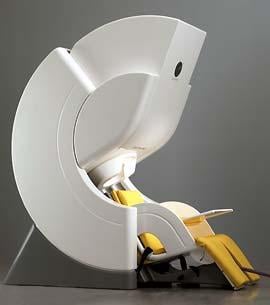
May 28, 2009 – The University Hospital at Heinrich-Heine-University in Düsseldorf, Germany, has installed Elekta Neuromag, a device for noninvasive measurement of brain activity using Magnetoencephalography (MEG) technology.
Completely non-invasive and painless, MEG is a powerful tool used for studying normal brain function, as well as brain disorders, such as epilepsy and autism.
The University has been utilizing MEG technology for more than 12 years; however, recently upgraded their Elekta system, allowing researchers to record human brain activity better and more accurately than before.
“After successfully using the old 122-channel Neuromag MEG system for
more than 12 years, I’m extremely excited about the installation of the
technologically-advanced 306-channel system,” says Professor Alfons
Schnitzler, M.D., Ph.D., head, Institute of Clinical Neuroscience and
Medical Psychology and Director, Center for Movement Disorders and
Neuromodulation, Heinrich-Heine-University.
Researchers from various departments, such as neurology, clinical
neuroscience, neurosurgery, psychiatry, and experimental psychology will
employ MEG to track brain activity related to sensory, motor, cognitive and emotional functions, at high temporal and spatial resolution, in healthy human subjects, as well as patients with neurological and psychiatric disorders.
“One particular focus,” said Dr. Schnitzler, “will be on the identification and modulation of oscillatory networks involved in normal brain function and their alterations in movement disorders and other neuropsychiatric diseases.”
Dr. Schnitzler also notes that the Center for Movement Disorders and
Neuromodulation at HHU runs a comprehensive program on Deep Brain
Stimulation (DBS). DBS delivers a constant, low electrical stimulation to
the brain through implanted electrodes and is used to help partially
restore normal movements in Parkinson's Disease, tremor syndromes, dystonia and other movement disorders.
“The new MEG system will allow us to record brain activity from patients
with implanted DBS devices and to study mechanisms of DBS and other
neuromodulatory interventions,” continues Schnitzler. “In addition to MEG, state-of-the-art MRI, PET, high-density EEG, and stereotactic TMS
facilities, as well as intracranial recordings are available to complement
the picture obtained from MEG measurements. This combination will provide a unique, non-invasive window through the human skull, offering exciting perspectives for clinical and cognitive neuroscientists and clinicians.”
For more information: www.elekta.com

 October 07, 2026