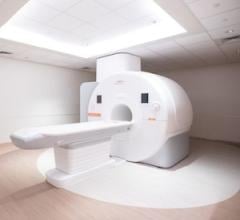
April 28, 2008 – Engineering students at the University of Florida designed a headset that may reduce the sound of loud noises produced by MRI examinations, aiming to provide a more positive experience for patients as well as reduce the number of examinations needed.

The air phones, which are similar headphones once distributed on commercial airplanes, pipe the sound via two tubes to tiny microphones connected to an amplifier and a signal processor several feet away. That processor taps an algorithm, or set of computer instructions, to produce a sound signal that is the opposite of the signal just received. That opposite signal then gets piped back through a third tube to each of the patient's ears.

Because the MRI sounds are repetitive and the piped-in sounds are timed to occur on top of the repetitions, the result is that the patient hears the same sound as he or she would have without any intervention - but at a lower volume.

Trials of the system using a loud beeping sound similar to some MRI noises showed it could reduce the noise by as much as 15 decibels. Ambient noise is about 60 decibels, with jet engines and other extremely loud noises reaching 120 decibels. The students were only able to reduce actual MRI sounds by a smaller level, but they said further tweaks of the system and algorithm are likely to improve that result.

The team's results are "significant and make a difference," said Gijs Bosman, a professor of electrical and computer engineering and the team's faculty adviser. "Based on experiments and further testing of the prototype, the team has come up with several recommendations for further improvements."

For more information: www.ufl.edu


Related Content

News | Advanced Visualization

Nov. 20, 2025 — Avatar Medical and Barco have launched Eonis Vision, marking a new evolution in how medical imaging is ...

Time November 20, 2025
arrow
News | Neuro Imaging

Nov. 19, 2025 — Royal Philips has announced an extended partnership with Cortechs.ai. Together, the companies will ...

Time November 19, 2025
arrow
Feature | Teleradiology | Kyle Hardner

Once viewed as a solution for after-hours coverage, teleradiology is rapidly expanding into a critical part of radiology ...

Time November 06, 2025
arrow
News | Radiology Imaging | UC San Diego Health

Oct. 16, 2025 — A strategic collaboration between UC San Diego Health and GE HealthCare will focus on bringing advanced ...

Time October 20, 2025
arrow
News | Computed Tomography (CT)

Sept. 26, 2025 — At the American Society for Radiation Oncology (ASTRO) 2025 annual meeting in San Francisco, Calif ...

Time September 29, 2025
arrow
News | Computed Tomography (CT)

Aug. 26, 2025— Esaote North America, Inc., a provider of dedicated MRI, Ultrasound, and Healthcare IT solutions, has ...

Time August 27, 2025
arrow
News | RSNA 2025

Aug. 13, 2025 — Registration is now open for the RSNA 111th Scientific Assembly and Annual Meeting, the world’s leading ...

Time August 13, 2025
arrow
News | Radiology Imaging

Aug. 12, 2025 – Medical imaging methods such as ultrasound and MRI are often affected by background noise, which can ...

Time August 12, 2025
arrow
News | Artificial Intelligence

July 22, 2025 — GE HealthCare has topped a U.S. Food and Drug Administration (FDA) list of AI-enabled medical device ...

Time July 23, 2025
arrow
News | Prostate Cancer

July 16, 2025 — Artificial intelligence can improve diagnostic consistency and reduce false-positives in prostate cancer ...

Time July 22, 2025
arrow
Subscribe Now