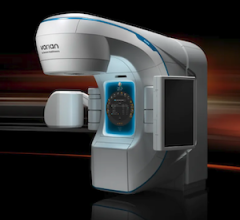
September 27, 2016 — Survival rates for elderly patients receiving stereotactic body radiation therapy (SBRT) for early-stage non-small cell lung cancer (NSCLC) rose from roughly 40 to 60 percent over the past decade, concurrent with the increasing adoption of SBRT, according to new research. The research was presented at the 58th Annual Meeting of the American Society for Radiation Oncology (ASTRO), Sept. 25-28 in Boston.
In recent years, SBRT has become the standard of care for patients with inoperable early-stage NSCLC. Compared to the conventional radiation therapy (RT) approach of small doses given daily over several weeks, SBRT delivers a highly targeted, escalated dose of radiation in a single session or as many as five of treatments, usually between one and five fractions. Widespread adoption of SBRT in community-based practices has increased its use as the primary definitive treatment for elderly patients, who often have multiple medical problems that limit surgical options.
For this study, researchers examined records from the nation’s largest cancer patient database to determine how rates of overall and disease-specific survival have changed as use of SBRT has increased, as well as to draw population-based comparisons between SBRT and surgery alone for elderly patients.
Records for the 62,213 patients age 60 and above who were diagnosed with stage I NSCLC between 2004 and 2012 were extracted from the National Cancer Institute’s Surveillance, Epidemiology, and End Results (SEER) database. Patients with squamous, adenocarcinoma and adenosquamous histologies and those with definite records defining local therapy were eligible for inclusion.
Overall survival (OS) and lung cancer-specific survival (CSS) rates were calculated for patients grouped into five-year subsets (i.e., 60-64, 65-69, 70-74, 75-79, 80-84, 85-89, and 90 and older). Researchers analyzed OS and CSS change over time based on type of therapy and age using Kaplan-Meier, logarithmic ranking and Cox multivariate hazard ratio (HR) methods, as well as comparative analysis with Fisher test.
Over the study period, survival rates for SBRT rose dramatically among this large, nationally-representative population of elderly stage I NSCLC patients. From 2004 to 2012 — the years in which adoption of SBRT in community practice became widespread — the overall survival rate at 23 months following SBRT alone rose nearly 20 percentage points, from 39 to 58 percent (p < 0.001). OS rates for surgery alone rose five percentage points, from 79 to 84 percent (p < 0.001). There was no improvement for patients who received neither RT nor surgery (from 28 to 33 percent, p = 0.29).
In the same time period, CSS increased from 48 to 72 percent of patients who received SBRT alone (p < 0.001) and from 87 to 91 percent of patients receiving surgery alone (p < 0.001). CSS rates remained stable for patients who received neither surgery nor radiation, although the difference approached statistical significance (38 to 45 percent, p = 0.06).
“Our findings indicate that physicians should feel confident recommending radiation therapy to patients who are too sick to undergo surgery or who choose not to undergo surgery for other reasons,” said Andrew M. Farach, M.D., a radiation oncologist at Houston Methodist Hospital and lead author on the study. “With continued adoption of SBRT in community cancer centers, it is our hope that more patients will receive curative SBRT and the number of patients left untreated based on age or medical comorbidity will continue to fall.”
The use of surgery to treat stage I NSCLC declined with age (p < 0.001). While 81 percent of patients age 60-64 underwent surgery, only 47 percent of patients age 80 or older were able to undergo surgery. The use of RT, conversely, rose with increasing age, ranging from 11 percent of patients age 60-64 to 39 percent of patients age 90 or above (p < 0.001). The number of patients receiving no treatment also increased from 7 to 40 percent for the youngest and oldest elderly patient cohorts in the study.
Despite improvements in OS and CSS, survival rates following RT remained lower than those for elderly patients who received surgery. Researchers explained that this difference may be due, in part, to a selection bias where healthier patients were treated with surgery, and they underscored the need for a controlled clinical trial with matched patients receiving each treatment first-line to compare the efficacy of these therapies. Instances of palliative SBRT or conventional RT also may have skewed results in favor of surgical outcomes.
“While survival rates remain highest for surgical candidates, this study demonstrates both clear benefits from SBRT for nonsurgical NSCLC patients and that outcomes following radiation therapy have improved at a more accelerated pace over the past decade than those for any other therapeutic approach,” said Farach. “With increased access to this potentially life-saving treatment, we can continue to improve outcomes for the growing population of elderly patients fighting early stage cancer.”
For more information: www.astro.org

 October 13, 2026