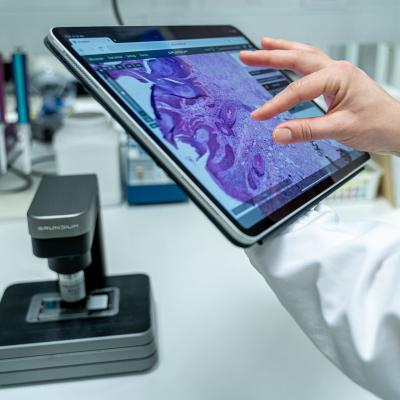
Ocus 40 (Photo: Grundium)
Oct. 23, 2025 — Working together, Grundium, a specialist in digital imaging for pathology, and Washington University, St. Louis (WashU), have shown that Grundium’s technology matches the diagnostic accuracy of traditional methods while decreasing turnaround times and improving patient care. Using Grundium's compact scanners, the university’s pathology team transformed how rapid on-site evaluations (ROSE) and frozen sections are performed across six different locations.
The initiative addresses several critical challenges in pathology: rising cancer incidence, limited availability of qualified pathologists and cytologists, and workflows that are often too slow or fragmented to meet patient needs.
ROSE plays a vital role in ensuring that biopsy samples are adequate for diagnosis and downstream testing. However, conventional ROSE requires pathologists to travel between procedure laboratories and hospitals, spending significant time in transit, as well as downtime waiting while samples are prepared on-site. For example, a facility the size of WashU includes 20 different sites across a campus covering more than one square mile.
“Traditional ROSE methods demanded a lot of waiting and travel for pathologists. In a campus the size of WashU’s, I’d often spend up to a whole hour per day just walking to and from on-site evaluations. And now we have added sites up to 25 miles away in different states,” said Hannah Krigman, MD, Professor, Pathology & Immunology at Washington University School of Medicine. “With digital telepathology, we provide immediate input without leaving our offices. This translates into faster diagnoses, greater efficiency, and a better experience for patients who may otherwise face repeat procedures, which delay final diagnosis.”
WashU’s pathology department implemented Grundium’s Ocus scanners to perform ROSE and frozen section reviews digitally. Slides were prepared at remote sites and scanned in real time, allowing pathologists to guide procedures, confirm adequacy, and render preliminary diagnoses while covering multiple geographically distant locations. This approach replaced hours of daily travel and waiting time with active case review, translating into the equivalent of an additional workday of diagnostic productivity each week. Furthermore, such an approach enables WashU to provide sub-speciality expertise for remote sites and smaller institutions.
“WashU’s work with digital ROSE and frozen sections shows how new technology directly addresses the resource challenges impacting hospitals and pathology labs worldwide,” said Todd Vanden Branden, Senior Director, Marketing and Field Applications at Grundium. “When leading institutions demonstrate that digital workflows match traditional accuracy while dramatically improving efficiency and patient experience, it signals a turning point for the entire field. The future of diagnostics will not depend on where the pathologist is located, but on how quickly expertise can be connected to the point of care.”
The impact extends beyond workflow efficiency. Repeat biopsies cost thousands of dollars, delay treatment, and increase patient anxiety and inconvenience. Digital ROSE and frozen sections at WashU have reduced these risks by enabling pathologists to confirm adequacy in real-time and advise clinicians on collecting additional biopsy material if needed. In many cases, preliminary diagnoses are made while the patient is still sedated, accelerating access to the appropriate treatment.
“In addition to the increasing volume of cases, pathologists are also challenged by the growing complexity of what’s expected from a pathology service,” said Suzanne Crumley, MD, Associate Professor of Pathology & Immunology at Washington University School of Medicine. “With digital ROSE, we can confirm specimen adequacy in real time, guide clinicians on whether additional tissue is needed, and ensure the material collected supports advanced testing like molecular analysis. That means fewer repeat biopsies, faster access to targeted therapies, and more confidence that patients are getting the right care from the outset. For us, the ability to bring subspecialty-level expertise into every case has been particularly important.”
Grundium's compact Ocus whole slide scanners automate the process of digitizing microscope slides. The scanners produce high-resolution digital images of tissue and cell samples, which can then be accessed and shared online via a secure web browser. This eliminates the need for physical slide transport, reduces manual work, and enables remote collaboration among experts, streamlining the digital pathology workflow. Another advantage of the Ocus scanners is the “live view” capability, which allows the pathologist to view and control a slide more rapidly than traditional scanning. These features enable WashU to provide the same expertise for frozen sections in the bi-state region as they do for telecytology.
The company's scanners are already in use across leading medical institutions in North America and Europe, with planned expansions into markets where physician shortages pose even greater challenges to healthcare access.

 October 01, 2026