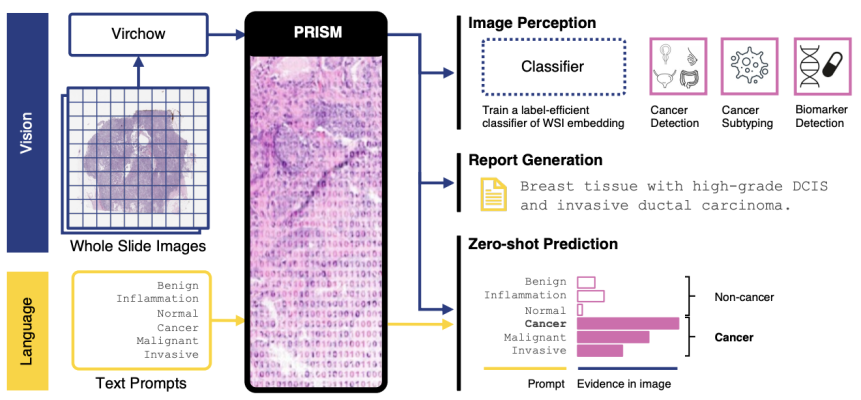
An overview of the capabilities enabled by the slide-level foundation model (PRISM), built on Virchow [43] tile embeddings. Whereas Virchow produces an embedding for each foreground tile of a set of whole slide images, PRISM aggregates these embeddings into a single slide embedding that can be used for image perception by training a linear classifier for downstream tasks including cancer detection, cancer sub-typing, and biomarker detection. Optionally, the model can be fine-tuned for the classification task. Language-enabled capabilities of PRISM include the training-free “zero-shot” prediction via text prompting, and generation of interpretable free text clinical reports.
May 30, 2024 — Paige, a global leader in end-to-end digital pathology solutions and artificial intelligence (AI) applications, announced the launch of a new service line based on Paige’s Foundation Models, including the world's largest multi-modal AI model in pathology and oncology. AI developers, organizations building computational pathology products, and life sciences companies will be able to license and use these Foundation Models to develop their own AI models for any research and development, clinical trials, experimental studies, or commercial needs while conforming to the highest set of privacy, security and clinical standards. The result could be a dramatic acceleration of innovation in precision oncology, improving the way cancer is diagnosed and treated around the world.
Unlike traditional AI development which requires task-specific models to be individually trained for a specific purpose and with specific data, Paige Foundation Models can be adapted to a broad range of downstream tasks without being trained on each individual task – saving development time and compute resources while reducing the data requirements traditionally required for state-of-the-art AI systems.
As part of this offering, customers will gain access to pre-trained models such as advanced versions of Virchow, the 1.5 million-slide scale model introduced last year--the world’s largest image-based AI model to fight cancer—and the newly released PRISM Foundation Model, a multi-modal slide-level model which offers added reporting and generative capabilities. The deep specificity and accuracy of PRISM allows AI teams to tap into analytical data related to advanced multi-tissue cancer and rare cancer detection, rare biomarker identification, cellular subtyping, spatial biology, and therapy response prediction that they could not have accessed with previous technology. Paige will also provide access to a dedicated AI support and services team to ensure partners can access the full power of Paige’s Foundation model quickly and accelerate their internal R&D timelines.
“Paige’s Foundation Models are powerful pre-trained technologies that now put AI capabilities at the fingertips of pharmaceutical companies, representing a significant step forward for drug discovery and development,” said Razik Yousfi, Senior Vice President of Technology at Paige. “They enable those who license the technology to reduce development time by lowering the resources required to obtain and curate data to train a model, build new and novel AI applications, while boosting current application performance. We are excited to offer this service to those working in high impact AI development in life sciences to revolutionize drug discovery and cancer treatment.”
"At Paige, our objective is clear - to make precision oncology a reality by identifying the right disease so that the right treatment can be prescribed," said Andy Moye, CEO at Paige. "The new service line powered by our Foundation Models pushes us one step closer to making this ambition a reality. With access to our Foundation Models, life sciences companies can drive intelligent drug discovery and increase their probability of success, which will have a direct impact on ensuring every patient receives the right treatment."
For more information: https://paige.ai/
 October 19, 2026