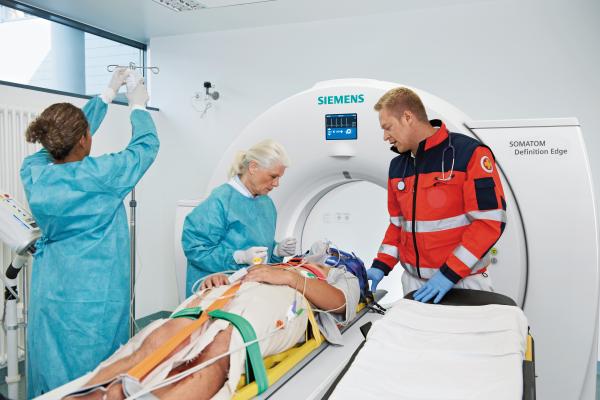
January 19, 2016 — Twice as many patients with non-serious injuries such as fractures or neck strain, are undergoing computed tomography (CT) scans in emergency departments at California hospitals, according to a University of California San Francisco (UCSF)-led study.
While CT scans enable clinicians to swiftly pinpoint life-threatening conditions, exposure to its ionizing radiation is associated with an increased risk of cancer. According to a 2009 report by the U.S. Food and Drug Administration (FDA), a single CT scan may be associated with a fatal cancer in one in 2,000 patients.
In the study, appearing in the Journal of Surgical Research, researchers at UCSF and Stanford studied more than 8 million adult patient visits at 348 state hospitals from 2005 to 2013, using data from the California Office of Statewide Health Planning and Development. These patients had been discharged after being seen in emergency departments for injuries such as minor falls or low-impact vehicle accidents. The study found that 3.51 percent of patients underwent at least one CT scan in 2005, versus 7.17 percent in 2013.
“The reasons for this increase are multifactorial,” said senior author Renee Hsia, M.D., professor of emergency medicine and health policy at UCSF. “They range from defensive medicine practices and the superior diagnostic accuracy of CT scans compared with X-rays, to their increased availability and convenience in emergency departments, and the demand to expedite discharge of patients.”
The authors noted that CTs were more likely to be ordered in hospitals that were designated high-level trauma centers. Some 39 percent of those in the study were ordered at level I and II trauma centers, compared with 3 percent at low-level centers.
“This may reflect an underlying work culture largely centered around the management of severely injured patients, guided by standard trauma CT protocols, and also the fact that level I and II trauma centers see sicker patients,” the authors wrote in their paper.
Also disproportionately visible were patients between the ages of 18 and 24, “those at greatest risk for radiation,” wrote the authors, as well as those over 45. “With the aging of the U.S. population, physicians may be influenced toward greater advanced imaging even in the case of low-mechanism injuries, given the atypical presentations and more serious pathology that older adults may have,” said Hsia.
The authors reported an upswing in the use of CTs from 2005 to 2009, followed by a gradual decline to 2011 — reflecting awareness of overuse — which was preceded by a resurgence from 2011 to 2013 that almost reached the zenith of 2009.
“The message for both patients and physicians is that there are long-term risks associated with radiation exposure and there may be situations where imaging is not definitively warranted or beneficial,” said Hsia.
“We can’t conclusively say which cases should not involve imaging, since every patient and every circumstance is different, but given that it is getting easier and easier to get CT scans, we need to be cautious in weighing their risks and benefits.”
Co-authors are Kristan Staudenmayer, M.D., of the Department of Surgery at Stanford University School of Medicine and Gregory Tong, a medical student at UCSF.
For more information: www.ucsf.edu

 October 07, 2026