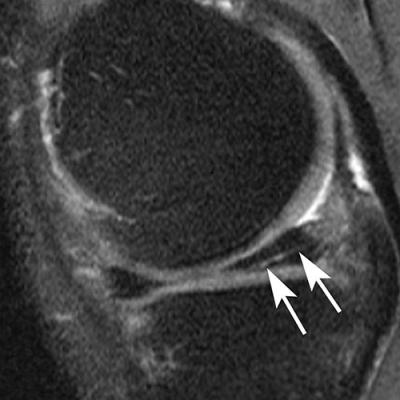
Sagittal intermediate-weighted fat-saturated image shows a typical horizontal-oblique meniscal tear of the posterior horn reaching the undersurface of the meniscus (arrows).
December 4, 2014 — According to research presented at RSNA 2014, decision for knee surgery requires careful consideration in order to avoid accelerated disease onset.
The new study focused on the meniscus, a wedge-shaped piece of cartilage in the knee that acts as a shock absorber between the femur and tibia. The two menisci in each knee also play an important role in joint stability. Meniscal tears are among the most common knee injuries, and surgery is often performed to alleviate pain.
Frank W. Roemer, M.D., and colleagues examined data from the Osteoarthritis Initiative, a large, ongoing observational study of knee osteoarthritis incidence and progression for the study. Patients were on average 60.2 years old and predominantly overweight, with a mean body mass index (BMI) of 28.3. Approximately two-thirds of the patients were women.
The researchers studied magnetic resonance imaging (MRI) exams of 355 knees that developed osteoarthritis during a five-year period, and a control group that was matched for age, gender, arthritic severity in both knees and BMI. Of all knees, 31 underwent meniscal surgery during the year prior to the arthritis diagnosis, and 280 knees had signs of meniscal damage on MRI but did not have surgery. Also part of the analysis were control cases with no meniscal damage. The researchers assessed the risk of developing arthritis and cartilage loss during the following year for the different groups.
All 31 of the knees that underwent meniscal surgery during the prior year developed osteoarthritis, compared with 165 (59 percent) of the knees with meniscal damage that didn't have surgery. In addition, cartilage loss was much more common among knees that had undergone surgery: 80.8 percent of knees with surgery showed cartilage loss, compared with 39.5 percent of knees with meniscal damage and no surgery.
An alternative to surgery is conservative management where physical therapy is prescribed to help maintain and restore muscle strength and range of motion. Symptoms are commonly treated with ice and non-steroidal anti-inflammatory medications.
Co-authors on the study are Ali Guermazi, M.D., Ph.D.; C. Kent Kwoh, M.D.; Michael Hannon, M.A.; Jason Grago, M.A. and David J. Hunter, M.D., Ph.D.
For more information: www.RSNA.org

 October 07, 2026