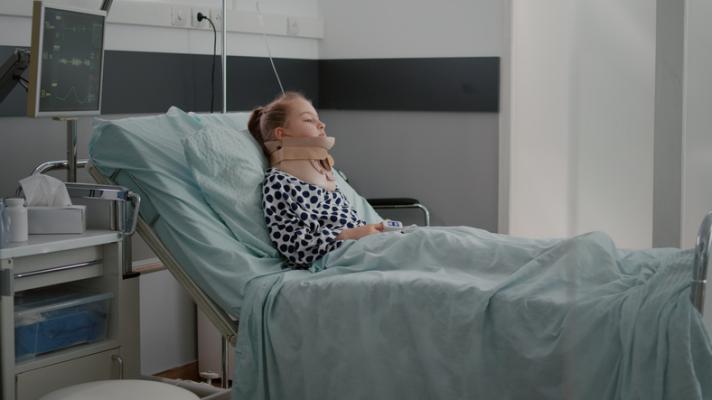
In a newly-published study, researchers from the Pediatric Emergency Care Applied Research Network (PECARN) outline a novel approach to predicting cervical spine injuries in children that reduces the need for imaging by half, while ensuring injuries are not missed. Image courtesy: Getty Images
June 13, 2024 — Cervical spine injuries in children are relatively rare but can have serious consequences, like paralysis. The standard method for detecting these injuries involves X-rays and computed tomography (CT) scans, which expose children to radiation and may pose long-term health risks. In the paper, “PECARN prediction rule for cervical spine imaging of children presenting to the emergency department with blunt trauma: a multicentre prospective observational study,” published June 3 in The Lancet Child & Adolescent Health, researchers from the Pediatric Emergency Care Applied Research Network (PECARN) outline a novel approach to predicting cervical spine injuries in children that reduces the need for imaging by half – while ensuring injuries are not missed.
“Quickly and accurately identifying children with potentially severe injuries is crucial for emergency medical providers,” said Julie Leonard, MD, MPH, who led the PECARN study team and is a pediatric emergency medicine physician at Nationwide Children’s Hospital. Leonard added, “Our extensive, multicenter study demonstrates that using this rule, which relies solely on self-reported symptoms and physical examination, can prevent unnecessary radiation in children.”
Children are more sensitive to radiation exposure than adults because their tissues and cells are still developing. Imaging can also be stressful for a child and their family, contribute to long wait times in emergency departments, and come with high costs. In addition, research demonstrates disparities in imaging use in emergency departments. Evidence-based rules can help ensure standardization of care.
The new model incorporates nine risk factors, all identifiable by the physical examination. Among the 22,000 study participants, only 0.2% without any of these risk factors had a clinically significant cervical spine injury, suggesting that these children can be safely evaluated without imaging.
About PECARN
Part of the Emergency Medical Services for Children (EMSC) Program, PECARN is the first and only federally funded research network dedicated to advancing clinical knowledge in pediatric emergency care. The network includes researchers from 18 emergency departments and 9 EMS agencies across 14 states. Learn more at https://pecarn.org/.
PECARN is supported by the Health Resources and Services Administration (HRSA) of the U.S. Department of Health and Human Services (HHS) as part of awards totaling $4,950,000 with 0% financed with non-governmental sources. The contents are those of the author(s) and do not necessarily represent the official views of, nor an endorsement, by HRSA, HHS, or the U.S. Government. For more information, visit HRSA.gov.
About the Abigail Wexner Research Institute at Nationwide Children’s Hospital
According to a written statement about the study, named to the Top 10 Honor Roll on U.S. News & World Report’s 2023-24 “Best Children’s Hospitals,” Nationwide Children’s Hospital is one of America’s largest not-for-profit, free-standing pediatric health care systems, and is home to the Department of Pediatrics of The Ohio State University College of Medicine. It added that the Abigail Wexner Research Institute at Nationwide Children’s is one of the Top 10 National Institutes of Health-funded free-standing pediatric research facilities in the U.S.
More information: www.pecarn.org
Reference:
PECARN prediction rule for cervical spine imaging of children presenting to the emergency department with blunt trauma: a multicentre prospective observational study - DOI: https://doi.org/10.1016/S2352-4642(24)00104-4

 October 05, 2026