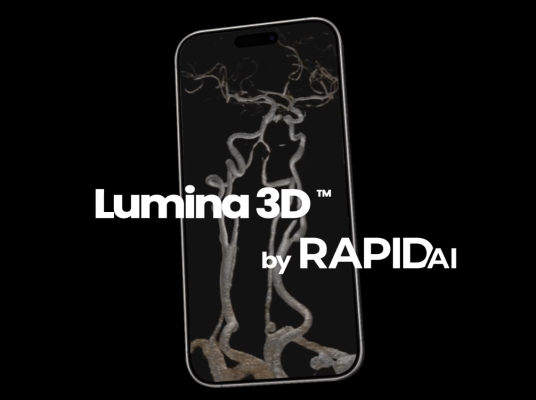
Feb. 3, 2025 — RapidAI has received FDA 510(k) clearance for Lumina 3D by RapidAI — an automated 3D imaging reconstruction solution designed to replace manual workflows with an AI-powered approach based on the latest groundbreaking AI technology advances.
“Obtaining high-quality 3D images within minutes of a CTA scan marks a significant advancement and milestone in neuroradiology,” stated Vivek Yedavalli, M.D., chief of neuroradiology at Johns Hopkins School of Medicine. “When radiologists require a detailed view of the vasculature for an accurate diagnosis, challenges related to quality, availability, time, and cost present major obstacles. As Head and Neck CTA volumes increase, we continue to face a shortage of CT technicians and neuroradiologists. Lumina 3D addresses these issues by providing near real-time, crystal-clear 3D views, vessel segmentation, and bone removal. This technology can assist in detecting anomalies, dissections, and stenosis more swiftly and accurately, potentially improving patient outcomes, significantly enhancing neuroradiologists’ workflows, and supporting the radiology community.”
Manual CTA reconstructions take considerable time, even with available resources, and turnaround times may stretch to hours, which can delay critical diagnoses and significantly hinder radiologists and neuro-interventionalists. Lumina 3D accomplishes this in minutes and runs in real-time. It is designed for large-scale applications, ensuring 24/7 availability for hospitals of all sizes. Engineered for speed, accuracy, and efficiency, Lumina 3D alleviates the workload for imaging technologists and radiologists, boosts productivity, and can accelerate diagnosis and treatment processes, ultimately enhancing patient care and hospital throughput.
“Having immediate access to high-quality 3D images of vascular structures marks a significant advancement in neuro-interventional surgery. Previously, navigating challenging anatomy required a process of trial and error. Lumina 3D changes the paradigm by removing the guesswork with near-instantaneous visualization of complex anatomy. With a 98% DICE score and results available in minutes, Lumina 3D's level of automation, speed, and accuracy is unprecedented. We are entering an era of precise procedural planning where initial device selection is optimized for individual patient anatomy. Joining the best-in-class RAPID suite of products, this is a technology that delivers not just better imaging, but potentially better outcomes,” said Daniel Gibson, M.D., neuro-interventionalist, Goodman Campbell Brain & Spine, Ascension Health (Indianapolis, USA).
As part of the Rapid Enterprise Platform, Lumina 3D seamlessly integrates into existing workflows, providing reconstructions to clinicians throughout the hospital network. Neuro-interventional specialists can directly visualize compressed images of the aortic arch, carotid tortuosity, and entire neurovasculature on mobile devices. This enables faster and more accurate access planning and catheter selection, thereby reducing procedure times and enhancing first-pass reperfusion rates. Lumina 3D is exclusively deployed on Rapid Edge Cloud, the only engine in the industry that offers hospitals the flexibility of on-premises, cloud, or hybrid infrastructure. This ensures unmatched speed, security, and scalability—a significant advantage for healthcare institutions optimizing AI-driven imaging solutions.
“At RapidAI, our brand promise extends beyond just providing AI solutions—we are dedicated partners in navigating the evolving complexities of clinical decision-making and care coordination for radiologists and interventionalists,” said Karim Karti, chief executive officer at RapidAI. “By delivering the most advanced deep clinical AI-driven insights for imaging support, improving workflow efficiency, and providing measurable ROI for hospital service line programs, we empower clinicians to make faster, more confident decisions. Lumina 3D builds upon our deep clinical expertise in neuroscience, redefining AI-powered 3D imaging and paving the way for the next generation of advanced AI imaging and clinical decision-making technology.”
For more information, please visit www.rapidai.com

 September 24, 2026