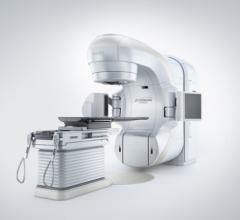
September 22, 2008 - Using the Novalis Tx platform from Varian Medical Systems and BrainLAB, doctors are performing image-guided radiosurgery to treat tumors of the brain, spine, lung and liver, without a single incision in the patient.
This advanced technology is on display this week at ASTRO 2008 and at the Congress of Neurological Surgeons 2008 meeting in Orlando, FL.
Doctors are turning more and more to the use of stereotactic body radiosurgery (SBRT) for the treatment of cancer and other conditions.
“Novalis Tx is a very versatile machine that will facilitate image-guided treatment for a variety of body sites,” said Naren Ramakrishna, M.D., Ph.D., chief, CNS (central nervous system) radiation oncology, Brigham and Women’s/Dana Farber. “Combining the advanced technologies for imaging, treatment planning, and treatment delivery from both companies, it offers clinicians a fast, versatile, highly precise radiosurgery device for image-guided treatments of the brain or body.”
Novalis Tx reportedly enables doctors to deliver fast radiosurgery treatments for a large number of indications, including malignant and benign lesions, brain metastases, arteriovenous malformations and functional lesions. Designed for fast, precise, noninvasive radiosurgical procedures, the Novalis Tx has been adopted by leading academic institutions, regional medical centers, and community hospitals such as Duke University, UCLA, Brigham and Women's Hospital/Dana-Farber Cancer Institute; Henry Ford Health System; Oregon Health & Science University; Palo Alto Medical Foundation; Tata Memorial Hospital in Mumbai; and the University of Bern, Switzerland.
The Novalis Tx platform incorporates two complementary imaging systems that work together to enhance treatment precision by enabling doctors to target areas being treated. The ETX (ExacTrac) room-based X-ray imaging system provides real-time imaging and fine-tuning of a robotic couch that moves in six dimensions to ensure that the targeted lesion is aligned with the treatment beam during treatment. The OBI (On-Board Imager) cone-beam CT imaging system quickly generates a high-quality 3D image of the targeted lesion and surrounding tissues, so clinicians can see the precise location and shape of the tumor, fine-tune the patient’s position and make sure that the internal anatomy has not shifted or changed prior to treatment.
For more information: www.varian.com, www.brainlab.com
 October 01, 2026