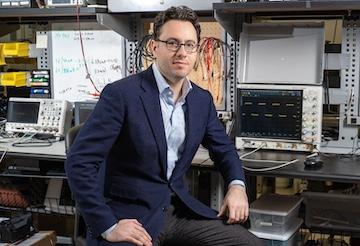
Stavros Zanos, MD, PhD
March 31, 2025 — Neuropathic pain affects up to 10 percent of the global population and can be challenging to manage effectively with existing medications. As a possible alternative treatment option, scientists at Northwell Health’s Feinstein Institutes for Medical Research have discovered that ultrasound precisely targeted at the spinal cord can reduce neuropathic pain and neuroinflammation in preclinical models.
The study – published in Bioelectronic Medicine, an open-access journal distributed by the Feinstein Institutes and BMC, part of Springer Nature -- led by Weiguo Song, PhD, instructor, and Stavros Zanos, MD, PhD, associate professor in the Feinstein Institutes’ Institute of Bioelectronic Medicine, demonstrates that trans-spinal focused ultrasound (tsFUS) can reduce sensitivity and suppress spinal microglia activation in neuropathic pain.
“This research provides compelling preclinical evidence that tsFUS could offer a safe and effective approach for managing neuropathic pain,” said Dr. Zanos. “By targeting the spinal cord directly, we can potentially modulate underlying mechanisms driving pain without the need for invasive procedures or pain medications.”
Neuropathic pain is a type of chronic pain caused by damage or dysfunction in the peripheral nervous system that can cause burning, shooting, stabbing or tingling within the body. Common causes of neuropathic pain include diabetes, shingles, nerve compression, trauma or surgery, cancer and cancer treatments, or certain infections.
In this study of animal models, after nerve injury, tsFUS was aimed precisely at the spinal cord for three minutes a day, for three days. The researchers observed reduced pain sensitivity, which persisted for weeks after the treatment concluded. It also calmed neuroinflammation in the spinal cord, a common complication of nerve injury.
“Dr. Zanos and his team are pioneering this non-invasive approach to target the spinal cord and reduce pain signals without the need for surgery or drugs,” said Kevin J. Tracey, MD, president and CEO of the Feinstein Institutes and Karches Family Distinguished Chair in Medical Research. “This research suggests the potential to treat nerve pain using focused sound waves that could lead to long-lasting relief for patients.”
The Feinstein Institutes for Medical Research is the global scientific home of bioelectronic medicine, which combines molecular medicine, neuroscience and biomedical engineering. At the Feinstein Institutes, medical researchers use modern technology to develop new device-based therapies to treat disease and injury.
Building upon years of research in molecular disease mechanisms and the link between the nervous and immune systems, Feinstein Institutes’ researchers discovered neural targets that can be activated or inhibited with neuromodulation devices, like vagus nerve implants, to control the body's immune response and inflammation. If inflammation is successfully controlled, diseases – such as arthritis, pulmonary hypertension, heart failure, inflammatory bowel diseases, diabetes, cancer and autoimmune diseases – can be treated more effectively.
Beyond inflammation, using novel brain-computer interfaces, Feinstein Institutes' researchers have developed techniques to bypass injuries of the nervous system so that people living with paralysis can regain sensation and use their limbs. By producing bioelectronic medicine knowledge, disease and injury could one day be treated with our own nerves without costly and potentially harmful pharmaceuticals.
Dr. Zanos was recently awarded $3 million from the National Institute of Neurological Disorders and Stroke (NINDS), part of the National Institutes of Health (NIH), in collaboration with imec, a research and innovation center in nanoelectronics and digital technologies, to pioneer a novel approach to vagus nerve stimulation (VNS). This research aims to develop more precise, safe and effective methods for stimulating specific fibers inside the vagus nerve, potentially transforming treatments for a range of chronic diseases.
 September 30, 2026