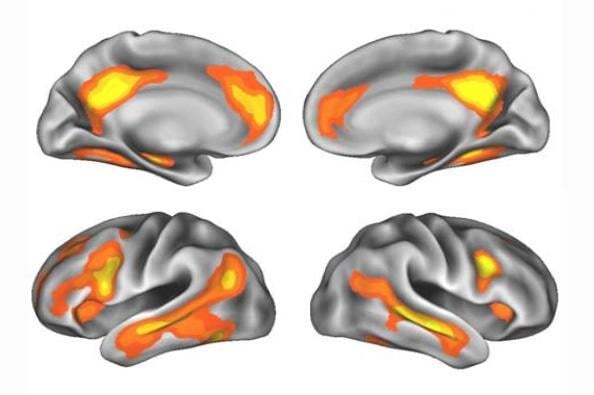
December 28, 2016 — Pregnancy involves radical hormone surges and biological adaptations, but the effects on the brain are still unknown. In this study a team of researchers compared the structure of the brain of women before and after their first pregnancy. This is the first research to show that pregnancy involves long-lasting changes — at least for two years post-partum — in the morphology of a woman's brain.
Using magnetic resonance imaging (MRI), the scientists have been able to show that the brains of women who have undergone a first pregnancy present significant reductions in grey matter in regions associated with social cognition.
The researchers believe that such changes correspond to an adaptive process of functional specialization towards motherhood. "These changes may reflect, at least in part, a mechanism of synaptic pruning, which also takes place in adolescence, where weak synapses are eliminated giving way to more efficient and specialized neural networks", said Elseline Hoekzema, co-lead author of the article.
According to Erika Barba, the other co-lead author, "these changes concern brain areas associated with functions necessary to manage the challenges of motherhood".
In fact, researchers found that the areas with grey matter reductions overlapped with brain regions activated during a functional neuroimaging session in which the mothers of the study watched images of their own babies.
In order to conduct the study, researchers compared magnetic resonance images of 25 first-time mothers before and after their pregnancy, of 19 male partners, and of a control group formed by 20 women who were not and had never been pregnant and 17 male partners. They gathered information about the participants during five years and four months.
The results of the research directed by Òscar Vilarroya and Susanna Carmona demonstrated a symmetrical reduction in the volume of grey matter in the medial frontal and posterior cortex line, as well as in specific sections of, mainly, prefrontal and temporal cortex in pregnant women. "These areas correspond to a great extent with a network associated with processes involved in social cognition and self-focused processing", indicates Susanna Carmona.
The analyses of the study determine with great reliability whether any woman from the study had been pregnant depending on the changes in the brain structure. They were even able to predict the mother's attachment to her baby in the postpartum period based on these brain changes.
The study took into account variations in both women who had undergone fertility treatments and women who had become pregnant naturally, and the reductions in grey matter were practically identical in both groups.
Researchers did not observe any changes in memory or other cognitive functions during the pregnancies and therefore believe that the loss of grey matter does not imply any cognitive deficits, but rather: "The findings point to an adaptive process related to the benefits of better detecting the needs of the child, such as identifying the newborn's emotional state. Moreover, they provide primary clues regarding the neural basis of motherhood, perinatal mental health and brain plasticity in general", says Oscar Vilarroya.
Elseline Hoekzema (researcher at the UAB at the time of the study, but currently working at Leiden University) and Erika Barba-Müller (UAB) are the lead authors of the article published in Nature Neuroscience.
The study was directed by Òscar Vilarroya, from the Cognitive Neuroscience Research Unit of the Department of Psychiatry and Legal Medicine at the UAB, and coordinator of the research group Neuroimaging of Mental Disorders at the IMIM Foundation, and co-directed by Susana Carmona. Carmona was a researcher at the UAB at the time of the study and now at the University Carlos III, Madrid, and affiliated to the CIBER of Mental Health (CIBERSAM).
Also collaborating in the research were Cristina Pozzobon, Florencio Lucco and Agustín Ballesteros (Valencian Infertility Institute, IVI); Marisol Picado (Hospital Clínic); Eveline A. Crone (Leiden University); David García-García and Manuel Desco (University Carlos III and Instituto de Investigación Sanitaria Gregorio Marañón, Madrid); and Juan Carlos Soliva and Adolf Tobeña (UAB).
Read the article in Nature Neuroscience at www.nature.com/neuro/journal/vaop/ncurrent/full/nn.4458.html.

 October 09, 2026