News | Breast Imaging | August 04, 2025

Triple-negative breast cancer is a highly aggressive breast cancer subtype lacking targeted therapies. Neoadjuvant chemoimmunotherapy improves pathologic complete response  rates, although patient selection is challenging.

MRI Model Predicts Neoadjuvant Chemoimmunotherapy Response in Triple-Negative Breast Cancer

Aug. 1, 2025 — The American Roentgen Ray Society’s American Journal of Roentgenology (AJR) has published a clinically practical model for early pathologic complete response (pCR) prediction in patients undergoing neoadjuvant chemoimmunotherapy (NACI) for triple-negative breast cancer (TNBC).

“This MRI-based predictive model could facilitate timely tailoring of clinical regimens after immunotherapy initiation by informing optimal de-escalation strategies for responders while prompting therapeutic adaptations for nonresponders,” wrote senior and corresponding author Changhong Liang, MD, from the radiology department at Guangdong Provincial People’s Hospital and Key Laboratory of Artificial Intelligence in Medical Image Analysis and Application at Southern Medical University in Guangzhou, China. 

Changhong Liang
 Changhong Liang, MD

Liang et al.’s AJR manuscript included patients with TNBC undergoing NACI and who underwent breast MRI including dynamic contrast enhancement before treatment and after the first treatment cycle (i.e., early NACI), including a single-center training set of 90 women (mean age, 49 years; January 2018 to September 2024) and an external test set of 29 women (mean age, 46 years; date range unavailable) from publicly available trial data. Two radiologists evaluated MRI features, including percentage enhancement (PE) reduction, representing semiquantitative assessment of relative expansion of intralesional nonenhancing components after early NACI. A model for predicting pCR on definitive surgery after NACI completion was constructed in the training set using independent predictors from multivariable logistic regression analysis and was evaluated in the external test set.

Ultimately, Liang and colleagues’ model constructed to predict pCR in patients undergoing NACI for TNBC combined tumor unifocality on pretreatment MRI and early tumor shrinkage ≥ 37% and percentage enhancement reduction on MRI performed after one cycle. In an external test set, the model achieved AUC of 0.88, sensitivity of 74%, and specificity of 90%.


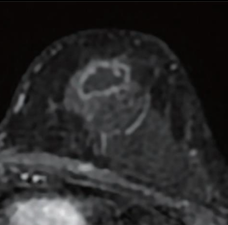
55-year-old patient with triple-negative breast cancer (TNBC) from training set
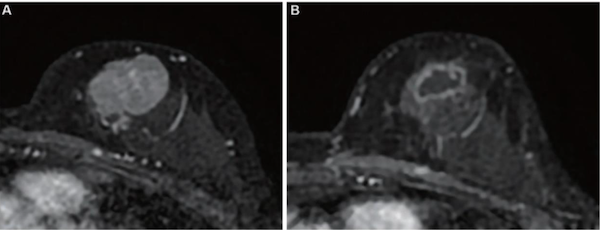
ARRS MRI Model
(A) Axial postcontrast T1-weighted image from baseline MRI examination shows unifocal enhancing mass (unifocality: positive). (B) Axial postcontrast T1-weighted image from MRI examination performed after 1 cycle of neoadjuvant chemoimmunotherapy (NACI) shows >37% reduction in lesion size (ETS: positive) and development of nonenhancing region within lesion (PE reduction: positive).


An online supplement to this accepted manuscript is also available.

Related Content

News | Magnetic Resonance Imaging (MRI)

July 7, 2026 — Imagion Biosystems, Ltd. recently announced it has renewed and extended its collaboration agreement with ...

Time July 07, 2026
arrow
News | Breast Imaging

July 7, 2026 — QT Imaging Holdings, Inc. recently announced it has successfully completed its first routine inspection ...

Time July 07, 2026
arrow
News | MRI Breast

July 2, 2026 – Quibim has announced the European and UK launch of QP-Breast, its CE and UKCA-marked AI tool which ...

Time July 02, 2026
arrow
News | Mammography

June 30, 2026 — The Food and Drug Administration has cleared new contrast-enhanced mammography (CEM) and CEM biopsy ...

Time June 30, 2026
arrow
News | Mammography

June 23, 2026 — Using artificial intelligence (AI), researchers found that image-based risk scores for breast cancer ...

Time June 24, 2026
arrow
News | Women's Health

June 2, 2026 — Results of an American College of Radiology-managed retrospective study involving 110,000 women presented ...

Time June 02, 2026
arrow
News

May 21, 2026 – Artera, the developer of multimodal artificial intelligence (MMAI)-based prognostic and predictive cancer ...

Time May 22, 2026
arrow
News | FDA

May 6, 2026 — Artera, the developer of multimodal artificial intelligence (MMAI)-based prognostic and predictive cancer ...

Time May 07, 2026
arrow
News | X-Ray

April 29, 2026 — Results from a new study* presented at the American Roentgen Ray Society’s (ARRS) 2026 annual meeting ...

Time April 29, 2026
arrow
News | Women's Health

April 16, 2026 – GE HealthCare has expanded its collaboration with DeepHealth, Inc., a wholly-owned subsidiary of RadNet ...

Time April 20, 2026
arrow
Subscribe Now