August 26, 2016 — Treatment with magnetic resonance imaging (MRI)-guided focused ultrasound significantly improves tremors and quality of life in patients with essential tremor (ET), according to a study published in the August 25 issue of the New England Journal of Medicine. Researchers at the University of Maryland School of Medicine (UM SOM) were among an international group of investigators studying this new non-invasive treatment, which was recently approved by the U.S. Food and Drug Administration (FDA), based on this research.
An estimated 10 million people in the United States are affected by ET, which, unlike Parkinson’s disease, has been viewed as a relatively benign disease caused by abnormalities in the brain. However, its disabling aspects – sometimes severe involuntary and rhythmic shaking in the hands and other extremities – can impair an individual’s ability to perform the simplest tasks, such as eating or holding a pen. Currently, ET affects an estimated 3 percent of Americans and has been treated by medication, surgical procedures or deep brain stimulation (DBS).
The randomized, double-blinded study showed that 56 patients who received the treatment experienced a nearly 50 percent improvement in their tremors and motor function after three months and retained a 40 percent improvement after a year. In contrast, 20 patients who received a sham treatment saw no improvement and were able to cross over into the treatment group three months later.
“We are very excited to have this new non-invasive treatment option for patients who struggle every day with this debilitating neurological disorder,” said study co-author Howard M. Eisenberg, M.D., the RK Thompson Professor and chair of neurosurgery at the UM SOM. “We saw an impressive reduction in tremors in hands and arms and an improvement in quality of life in patients who experienced no relief from medication.”
Twenty-two of the patients in the year-long study were treated at the University of Maryland Medical Center (UMMC), with many who received the new therapy achieving up to a 99 percent improvement in their tremors.
Paul Fishman, M.D., professor of neurology, pharmacology and neurobiology at UM SOM and chief of neurology for the Maryland VA Health Care System, and Dheeraj Gandhi, M.D., MBBS, professor of radiology, neurosurgery and neurology and director of interventional neuroradiology at UM SOM, are also co-authors of the study. W. Jeffrey Elias, M.D., director of stereotactic and functional neurosurgery at the University of Virginia, is the principal investigator and lead author.
There were eight sites for the clinical trial, five of them in the United States.
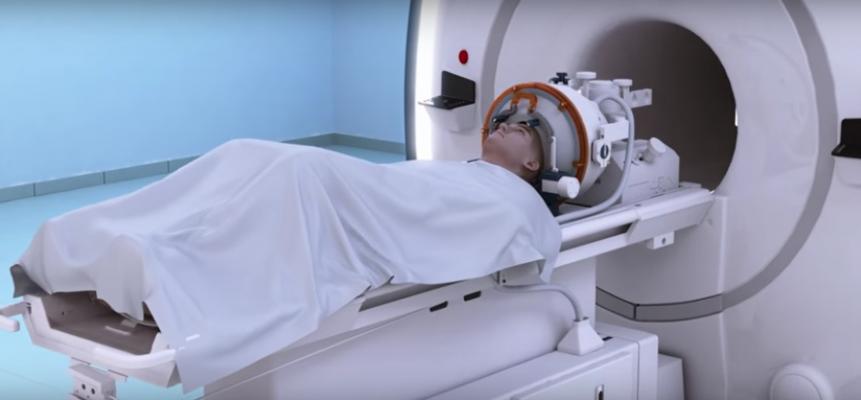
In the study, researchers looked at 76 patients who had essential tremor but had not responded to medication. They used MRI to guide ultrasound waves with a millimeter-wide focus through the intact skin and skulls of the study participants, in order to make precise ablations (surgical removal of tissue) in the thalamus, an area deep within the brain thought to play a key role in ET.
“You are raising the temperature in a very restricted area of the brain and that destroys the tissue,” said Eisenberg. “The ultrasound creates a heat lesion that you monitor through MRI.”
The entire procedure lasts two to four hours, and patients are awake and able to interact with the treatment team. Researchers ask patients to draw spirals on a piece of paper, which are then compared with drawings done before the treatment to determine its effectiveness in calming the tremor.
The study was funded by the Focused Ultrasound Foundation, BIRD Foundation and Insightec, the equipment’s manufacturer. Eisenberg is a consultant to both the Focused Ultrasound Foundation and Insightec.
“University of Maryland School of Medicine faculty physicians have been leaders in exploring the potential of MRI-guided focused ultrasound to treat essential tremor as well as Parkinson’s disease, two movement disorders that affect millions in the U.S. and around the world,” said UM SOM Dean E. Albert Reece, M.D., PhD, MBA, who is also vice president of medical affairs at the University of Maryland and the John Z. and Akiko Bowers Distinguished Professor at UM SOM.
“This groundbreaking study clearly demonstrates that focused ultrasound can be transmitted with precision through the human skull to target areas deep with the brain – and improve the quality of life of patients with essential tremor who have difficulty performing tasks that most of us take for granted,” Reece said.
For more information: www.nejm.org

 October 07, 2026