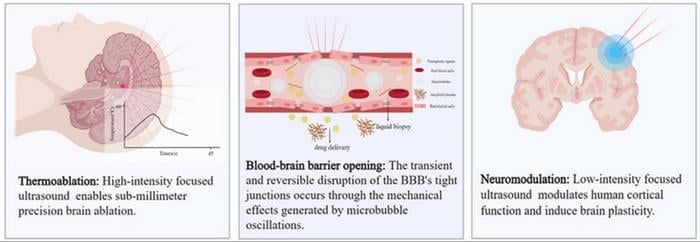
The mechanism of MRI-guided focused ultrasound. Graphic courtesy of Haoxuan Lu, Yujue Zhong, et al.
April 8, 2024 — Magnetic resonance-guided focused ultrasound (MRgFUS) is a non-invasive technique for neuroregulation. It offers several advantages, including being non-invasive, eliminates the need for general anesthesia requirement, and enables real-time target localization and real-time temperature monitoring. Currently, the U.S. Food and Drug Administration has approved this technology for the treatment of essential tremor and Parkinson's disease, and its indications are expanding to include various intracranial diseases.
In a new review published in the KeAi journal Meta-Radiology, a team of researchers from the Chinese PLA General Hospital in China summarized the clinical trials of high-intensity FUS in the treatment of intracranial diseases. The team searched the PubMed, Embase, and Web of Science databases from January 1, 2013, to November 1, 2023, using the search terms: “MRgFUS,” or “MRI-guided Focused Ultrasound,” or “magnetic resonance imaging-guided focused ultrasound,” or “magnetic resonance-guided focused ultrasound.”
“According to the inclusion and exclusion criteria for initial literature screening, we identified several current intracranial applications of magnetic resonance-guided high-intensity focused ultrasound, which include “essential tremor,” "Parkinson's disease,” “obsessive compulsive disorder,” “major depressive disorder,” “neuropathic pain,” and “focal dystonia”,” shares corresponding author Xin Lou.
The review also introduces the preclinical and clinical studies on low-intensity FUS-induced blood-brain barrier opening and neuromodulation, and discusses the challenges and future directions of MRgFUS technology.
“We found that MRgFUS has emerged as a novel therapeutic approach in functional neurosurgery. High-intensity FUS is a safe and effective treatment for various intracranial diseases. Nonetheless, the neurobiological effects of low intensity FUS- blood–brain barrier opening and neuromodulation are not fully understood. Therefore, further preclinical and clinical studies are required to explore these effects. Neuroimaging is essential for localizing targets and exploring potential neurobiological effects in MRgFUS,” concludes Lou.
For more information: https://www.keaipublishing.com/

 October 05, 2026