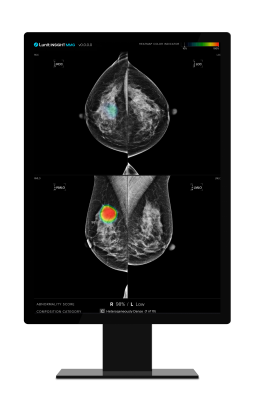
September 13, 2023 — Lunit, a leading provider of AI-powered solutions for cancer diagnostics and therapeutics, has unveiled the results of a collaborative study with Dr. Yan Chen, Ph.D., Professor of digital screening at the University of Nottingham, United Kingdom. The study, recently published in Radiology, demonstrates that Lunit's AI-powered mammography analysis solution, Lunit INSIGHT MMG, matches the diagnostic performance of human readers. The study, which involved comparing Lunit's solution with assessments by 552 human readers, represents a significant milestone in the field of medical imaging and the future of breast cancer detection.
"This first study to apply the Personal Performance in Mammographic Screening (PERFORMS) scheme to AI algorithms marks a remarkable achievement, showcasing our AI's ability to match human performance in detecting breast cancer. It offers hope to patients worldwide and underscores AI's potential to enhance cancer detection and treatment outcomes," said Brandon Suh, CEO of Lunit. "This follows our recent study in The Lancet Digital Health, validating Lunit INSIGHT MMG as a game-changing alternative in breast cancer screening. We're committed to leveraging AI to transform healthcare and save lives."
Conducted retrospectively, the study evaluated two PERFORMS test sets, each consisting of 60 challenging cases from the NHSBSP (National Health Service Breast Screening Program), over a three-year period. Human readers assessed these cases between May 2018 and March 2021, while Lunit's AI-powered mammography analysis solution evaluated them in 2022. The AI algorithm assessed each breast individually and assigned a suspicion of malignancy score to the detected features.
In the study, no significant difference was observed in the AUC (area under the ROC curve) between Lunit's AI-powered mammography analysis solution (0.93) and human readers (0.88), demonstrating the solution's ability to excel in breast cancer detection. Additionally, when using recall thresholds to match the mean performance of human readers (90% sensitivity, 76% specificity), Lunit's AI-powered mammography analysis solution exhibited no significant differences or even stronger performance in sensitivity (91%) or specificity (77%) compared to human readers, highlighting its reliability and consistency.
In conclusion, the study demonstrates that Lunit's AI-powered mammography analysis solution performs at a level equivalent to that of an experienced radiologist when assessing cases from two enriched test sets provided by the PERFORMS scheme.
“There are no other studies to date that have compared such a large number of human reader performance in routine quality assurance test sets to AI, so this study may provide a model for assessing AI performance in a real-world setting,” said Prof. Chen. "The results of this study provide strong supporting evidence that AI for breast cancer screening can perform as well as human readers.”
For more information: www.lunit.com
Related content:
Today's Mammography Advancements
Digital Breast Tomosynthesis Spot Compression Clarifies Ambiguous Findings
AI DBT Impact on Mammography Post-breast Therapy
ImageCare Centers Unveils PINK Better Mammo Service Featuring Profound AI
Radiologist Fatigue, Experience Affect Breast Imaging Call Backs
Fewer Breast Cancer Cases Between Screening Rounds with 3-D Mammography

 October 09, 2026