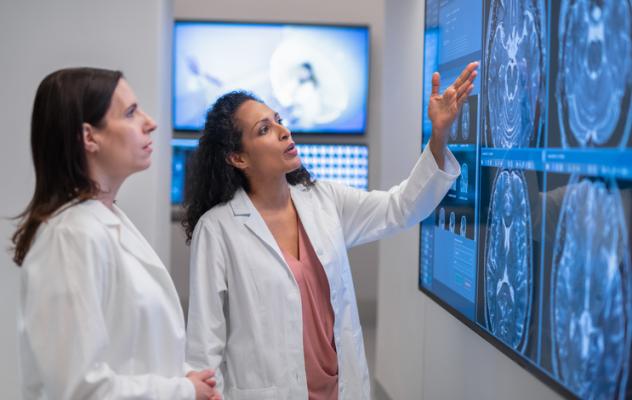
A new Harvey L. Neiman Health Policy Institute (HPI) study found that radiologists interpreted 72.1% of all imaging studies for Medicare fee-for-service beneficiaries in 2022, with the remaining 27.9% performed by other types of clinicians. Image courtesy: Getty Images
July 3, 2024 — A new Harvey L. Neiman Health Policy Institute (HPI) study found that radiologists interpreted 72.1% of all imaging studies for Medicare fee-for-service beneficiaries in 2022, with the remaining 27.9% performed by other types of clinicians. According to a written study summary released by HPI, market share varied by imaging modality; radiologists interpreted 97.3% of computed tomography (CT), 91.0% of magnetic resonance (MR), 76.6% of radiology/fluoroscopy (XR), 50.9% of nuclear medicine (NM), and 33.9% of ultrasound. The research, published June 28 in the Journal of the American College of Radiology, JACR, was based on 123 million Medicare Part B imaging claims in 2022. Additional study findings and highlights are shared below.
For non-cardiac imaging, the study found that radiologists interpreted nearly all imaging in the hospital outpatient, inpatient, and emergency department settings: 99.5% for CT; 99.4% for MR; 98.9% for NM; 97.9% for XR; and 79.3% for ultrasound. Even in the office setting, radiologists interpreted a majority of non-cardiac advanced imaging (84.4% of CT, 78.7% of MR, 85.4% of NM) but a minority of XR (43.1%) and ultrasound (29.2%), according to the study overview.
“There are economic benefits to non-radiologists that likely contribute to their majority market share of XR and ultrasound imaging. These providers have financial incentives for self-referral of imaging,” stated Eric Christensen, PhD, Research Director at the Neiman Institute. Christensen continued, “The Stark Law, which was designed in part to prohibit self-referral of imaging to facilities in which the referring physician had a financial interest, have largely been ineffective. The literature shows that even after the passage of the Stark Law, self-referring non-radiologists ordered 1.2 to 6.4 times more imaging studies than those who do not self-refer.”
“Non-radiologists have likely been more successful with capturing market share with XR and ultrasound than with advanced modalities because imaging volume from their practice’s patients alone may be sufficient for a positive return on investment for providing these services” stated coauthor Jeffrey Newhouse, MD, Professor Emeritus of CUIMC Department of Radiology, Columbia University Medical Center. “However, advanced imaging involves substantially higher capital and operational costs, making the economics impractical for most practices,” Newhouse added.
The study found that radiologist market share also varied by the focus body region, and in particular for cardiac imaging. For non-cardiac imaging, radiologists interpreted 97.6% of CT, 91.4% of MR, 95.6% of NM, 76.6% of XR, and 53.0% of ultrasound. In contrast, radiologists’ share of cardiac imaging was 67.6% of CT, 42.2% of MR, 11.8% of NM, and 0.4% of ultrasound.
“Cardiologists interpret most cardiac imaging, and a greater share than radiologists for all modalities except cardiac CT” stated Christensen, adding, “Cardiology is the only non-radiology specialty that interprets a large percentage of advanced imaging — CT, MR, and NM — but only cardiac imaging.”
The Harvey L. Neiman Health Policy Institute, based in Reston, VA, is one of the nation’s leading medical imaging socioeconomic research organizations, which studies the role and value of radiology and radiologists in evolving health care delivery and payment systems and the impact of medical imaging on the cost, quality, safety and efficiency of health care.
Persons interested in obtaining a copy of the study can contact Nichole Gonzalez at [email protected].
More information: www.neimanhpi.org
 October 05, 2026