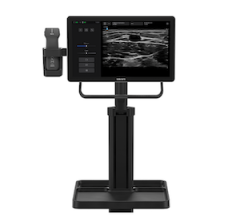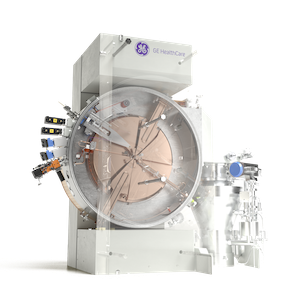
The MINItrace Magni is a compact cyclotron solution designed to simplify onsite production of PET tracers and radiometals. (Photo: GE HealthCare)
June 1, 2026 — At the 2026 Society of Nuclear Medicine and Molecular Imaging (SNMMI) annual meeting, GE HealthCare will showcase its latest technologies and AI-enabled workflows.
Nuclear medicine is undergoing rapid expansion as healthcare systems increase adoption of theranostics, broaden radiopharmaceutical access and invest in precision diagnostics and targeted therapies. This momentum is also evident in global nuclear medicine market projections, which anticipate growth from approximately $7.8 billion in 2024 to more than $30.7 billion by 2034iii.
“Nuclear medicine is moving from early innovation to large-scale clinical implementation,” said Jean-Luc Procaccini, president and CEO, Molecular Imaging and Computed Tomography (MICT), GE HealthCare. “Healthcare systems need technologies and workflows that help expand access, improve efficiency and support more confident clinical decision-making as theranostics adoption and precision care evolve.”
Turning Convergence into Clinical Reality
Growing demand for precision diagnostics and targeted therapies is helping accelerate the evolution of nuclear medicine. Advances in radiopharmaceuticals and imaging technologies help clinicians diagnose disease, improve treatment planning and expand access to personalized care. As adoption increases, healthcare systems are also facing new operational challenges – including how to scale infrastructure, streamline workflows and expand patient access beyond traditional hospital settingsiv.
Rising prevalence of chronic diseases is further driving demand for timely and advanced diagnoses and targeted treatment approaches. Fortunately, new care delivery models are already taking shape across care pathways. These models are increasingly enabled by advances in radiopharmaceuticals that expand access to PET imaging and support more scalable, routine clinical use across care settings.
Early examples of this shift are emerging to reach patients beyond traditional hospital environments:
-
Cardiology: GE HealthCare’s Flyrcado (flurpiridaz F 18 injection) is helping expand access to PET myocardial perfusion imaging (MPI) through a ready-to-use, unit-dose model designed for routine clinical workflows. The company is also collaborating with channel partners to accelerate the adoption of cardiac PET MPI in community settings while mobile imaging models are extending access beyond traditional hospital environments.
-
Neurology: As demand for Alzheimer’s diagnostics growsv, GE HealthCare offers Vizamyl (flutemetamol F 18 injection) and quantitative tools such as MIMneuro to support more consistent amyloid PET interpretation and clinical decision-making. These technologies can help providers integrate amyloid imaging more efficiently into routine neurological care pathways.
-
Oncology: Theranostics adoption is also acceleratingi, causing healthcare systems to seek more standardized approaches to imaging, treatment planning and response assessment. GE HealthCare’s StarGuide SPECT/CT, Intelligent Radiation Therapy (iRT) and MIM portfolio are designed with these needs in mind — helping simplify whole-body tumor burden assessment, streamline workflows and support more consistent treatment planning across care settings.
These capabilities also support GE HealthCare’s vision for Adaptive Theranostics — a connected, data-driven approach that integrates molecular imaging, quantitative analysis and multidisciplinary workflows to help tailor therapy decisions over time.
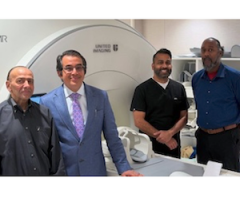
“This is an exciting moment for nuclear medicine because we are moving beyond simply detecting disease to truly understanding its biology and behavior,” says Dr. Munir Ghesani, MD, FACNM, FACR, FSNMMI, Chief Medical Officer at United Theranostics and System Chief of Nuclear Medicine at the Mount Sinai Health System in New York. “Technologies that combine advanced imaging, quantitative analysis and innovative radiopharmaceuticals are helping clinicians make more informed decisions earlier in the care pathway — ultimately improving how we diagnose, treat and monitor patients.”
GE HealthCare’s nuclear medicine portfolio spans imaging systems, AI-enabled software and pharmaceutical diagnostics designed to help clinicians support the full patient journey — from detection and diagnosis through therapy planning and monitoring.
Real-world Clinical Impact
At SNMMI 2026, GE HealthCare is highlighting key technologies and software designed to help healthcare systems scale precision imaging, theranostics and quantitative analysis across clinical and research settings:
Advanced imaging technologies
- MIM KineticIDvi: Advanced 510(k)-pending software designed for dynamic PET imaging and kinetic modeling, enabling quantitative, time-based analysis of radiotracer behavior to support more informed clinical and research decisions.
- MIM LesionID Pro: Recently 510(k) cleared by the U.S. FDA, this AI-powered software automates whole-body tumor burden analysis, reducing the need for manual lesion segmentation, physiologic uptake removal, or multi-image registration while enabling fast access to quantitative insights.
- Omni Legend: GE HealthCare’s PET/CT platform now has more than 500 installationsvii. Its high-sensitivity design supports faster scansviii, improved image quality and enhanced lesion detectabilityix. Omni Legend also includes Precision DL deep learning image processing.
- StarGuide: A digital SPECT/CT platform featuring 12 CZT detectors and optimized for certain theranostic procedures, enabling high-quality 3D imaging, short scan times and quantitation.
- MINItrace Magnix: A compact cyclotron solution designed to simplify onsite production of PET tracers and radiometals, including Gallium-68, helping expand radiopharmaceutical access and support more localized production and personalized care delivery.
Radiopharmaceuticals and imaging agents
- Flyrcado: A PET imaging agent that helps doctors evaluate myocardial ischemia and infarction in people with known or suspected coronary artery disease, including during exercise stress tests.
- DaTscan (ioflupane I‑123 injection): A proven neurological diagnostic radiopharmaceutical to visualize striatal dopamine transporters assisting in the evaluation of patients with suspected Parkinsonian syndromes (PSs) and suspected dementia with Lewy bodies (DLB).
- Cerianna (fluoroestradiol F 18 injection): A PET radiopharmaceutical used to detect estrogen receptor (ER)-positive lesions as an adjunct to biopsy in patients with recurrent or metastatic breast cancer.
- Vizamyl: A PET imaging agent used to estimate amyloid beta neuritic plaque density in adults with cognitive impairment to support evaluation of Alzheimer’s disease and other causes of cognitive decline, and to help inform selection of patients for amyloid beta-directed therapy as described in the prescribing information of the therapeutic products.
Together, these imaging technologies and agents are designed to support more scalable, data-driven and personalized nuclear medicine workflows across care pathways.
GE HealthCare: Preparing the Next Decade
As nuclear medicine adoption continues to grow, healthcare systems are increasingly focused on the operational requirements needed to support broader clinical use — including infrastructure, workflow standardization, radiopharmaceutical access and scalable decision supportxi.
Quantification and advanced imaging analytics are expected to play an increasingly important role in this evolution, particularly in neurodegenerative disease and theranostics, where more standardized interpretation and longitudinal assessment may help advance consistency across sites and clinicians.
GE HealthCare is using Adaptive Theranostics — a model that combines molecular imaging, quantitative analytics and connected clinical workflows to help clinicians personalize radioligand therapy decisions across treatment cycles. By supporting more consistent quantification, longitudinal assessment and multidisciplinary collaboration, Adaptive Theranostics is designed to help healthcare systems scale precision care as theranostics adoption grows.
“As molecular imaging continues to scale, success will depend on more than individual products – it requires building the ecosystem around them,” says Eric Ruedinger, Vice President and General Manager, Pharmaceutical Diagnostics (PDx), USCAN, GE HealthCare. “We’re focused on enabling that ecosystem end-to-end – from tracer development and manufacturing to expanding access, integrating workflows and advancing the tools that support confident, consistent decision-making – so precision care can move from promise to sustained, everyday practice.”
To learn more about GE HealthCare’s full suite of nuclear medicine solutions, please visit gehealthcare.com.
[i] Ezhilarasan, E., Sabarees, G. & Premkumar, P.P. Radioligand theranostics in oncology: emerging trends in target design and radiochemical innovation. J Radioanal Nucl Chem (2026). https://link.springer.com/article/10.1007/s10967-026-10891-3.
[ii] Research and Markets. Radiopharmaceuticals Market Report 2026. Dublin: Research and Markets, 2026 www.researchandmarkets.com/reports/5939063/radiopharmaceuticals-market-report.
[iii] Global Market Insights. U.S. Nuclear Medicine Market Size & Share, 2025–2034. Published October 2025. Accessed May 4, 2026. www.gminsights.com/industry-analysis/us-nuclear-medicine-market.
[iv] Global Market Insights. Nuclear Medicine Market Opportunity, Growth Drivers, Industry Trend Analysis, and Forecast 2025–2034. Published October 8, 2025. Accessed April 16, 2026. www.giiresearch.com/report/gmi1858986-nuclear-medicine-market-opportunity-growth-drivers.html?utm_source=chatgpt.com
[v] Grand View Research. U.S. Alzheimer’s Disease Diagnostics Market Report, 2030. San Francisco: Grand View Research, 2025. www.grandviewresearch.com/industry-analysis/us-alzheimers-disease-diagnostics-market-report.
[vi] MIM KineticID is 510(k)-pending with the U.S. FDA. Not CE Marked. Not available for sale in the United States, Europe, Canada, or any other region.
[vii] GE HealthCare data on file.
[viii] Up to 53% reduction of PET scan time on Omni Legend 32 cm compared to Discovery MI 25 cm, as demonstrated in phantom testing.
[ix] Omni Legend 32 cm increases small lesion detectability 16% on average and up to 20%, as compared to Discovery MI 25 cm with matched scan time/injected dose, as demonstrated in phantom testing using a model observer with 4 mm lesions; average of different reconstruction methods.
[x] MINItrace Magni is technology in development. Not CE marked.
[xi] Global Market Insights. Nuclear Medicine Market Opportunity, Growth Drivers, Industry Trend Analysis, and Forecast 2025–2034. Published October 8, 2025. Accessed April 16, 2026. www.giiresearch.com/report/gmi1858986-nuclear-medicine-market-opportunity-growth-drivers.html?utm_source=chatgpt.com


 October 05, 2026