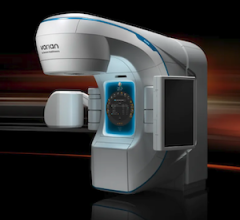
December 22, 2017 — The U.S. Food and Drug Administration (FDA) has cleared the new GammaPod noninvasive stereotactic radiotherapy system intended for use in treating cancer in breast tissue.
“With today’s clearance, patients will have access to a treatment option that provides greater accuracy in delivering radiation therapy to breast tumors while saving surrounding breast tissue,” said Robert Ochs, Ph.D., acting deputy director for radiological health in the Office of In Vitro Diagnostics and Radiological Health in the FDA’s Center for Devices and Radiological Health.
Radiation therapy is an important treatment option for cancer patients. Approximately 60 percent of all cancer patients will be treated with some form of radiation therapy. During radiation therapy, tumor cells are killed when their DNA is damaged by the radiation being absorbed into them. While radiation therapy has the potential to kill tumor cells, it can also damage healthy tissue around the tumor.
The GammaPod system is intended for use in the noninvasive stereotactic delivery of a radiation dose to a portion (partial volume) of the breast in conjunction with breast conserving treatment. During the procedure, radiation is delivered to specific areas of the breast. The GammaPod has not been shown to be as effective as whole breast radiation therapy (WBRT) and is not intended to replace WBRT.
The GammaPod system is a dedicated stereotactic radiation therapy technology designed to treat breast cancer. GammaPod uses thousands of focused beams of radiation from 36 rotating radioactive Cobalt-60 sources in combination with a two-layer, vacuum-assisted cup that immobilizes the breast to achieve a more accurate delivery of radiation. The GammaPod design to immobilize the breast during treatment provides the benefit of minimizing the radiation dose to the surrounding healthy tissues in the breast, heart and lungs.
The FDA reviewed scientific evidence, including a clinical study of 17 patients that tested the feasibility of accurately delivering the prescribed dose to the breast tumor while minimizing radiation to the healthy tissue. The clinical evidence supports delivering the prescribed dose to the breast tumor with minimal radiation-induced side effects such as skin redness or erythema.
The GammaPod system was reviewed through the premarket notification 510(k) pathway. The FDA granted clearance of the GammaPod to Xcision Medical Systems LLC.
For more information: www.xcision.com

 October 19, 2026