February 17, 2017 — Accuray Inc. recently announced data from a prospective, Phase II, 17-center study which showed that treatment with the CyberKnife System for low- and intermediate-risk prostate cancer provides excellent long-term results. At five years, the disease-free survival rate for low-risk prostate cancer patients was 100 percent and for intermediate-risk patients was 88.5 percent. These results were maintained by patients followed for seven years.
The study was presented at the American Society of Clinical Oncology Genitourinary Cancers Symposium (ASCO GU) Feb. 16-18, 2017, in Orlando, Fla.
A low prostate-specific antigen (PSA) value is associated with a reduced risk of cancer recurrence or metastases. The lower the PSA value and the longer it continues to decline, the greater the patient's likelihood of achieving long-term disease free survival1. According to the study, the five-year median PSA was 0.1 ng/mL for low- and intermediate-risk prostate cancer patients receiving stereotactic body radiation therapy (SBRT) administered with the CyberKnife System. The median PSA value subsequently decreased to 0.035 ng/mL at the seven-year mark for patients followed to this time point.
All patients participating in the study were treated with the CyberKnife System. Seventeen institutions analyzed 259 prostate cancer patients; 112 low-risk and 147 intermediate-risk. Patients received an HDR-like heterogeneous dosing regimen of 38 Gy/four fractions delivered by the CyberKnife System. The primary study objectives were to determine biochemical disease free survival (bDFS) and measure the rates of acute and late genitourinary and gastrointestinal toxicities following treatment, and to compare the CyberKnife System bDFS rates to published HDR brachytherapy bDFS rates reported in the literature.
Unique aspects of this study included:
- A highly effective pattern of radiation could be delivered easily by any CyberKnife user as a routine part of their practice — such plans require steep dose fall-off from high-dose regions to rectum, and would be difficult to deliver safely without continual image-guidance and automatic correction of beam aim;
- Treatment resulted in among the lowest PSA levels reached after radiation therapy (PSA nadirs); and
- The entire treatment was completed in four days.
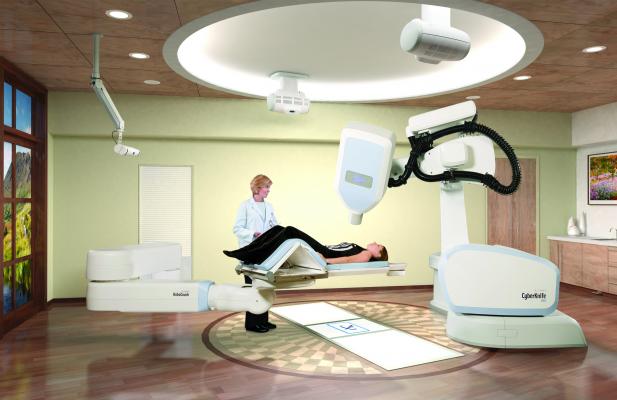
The CyberKnife System was designed to deliver SBRT, a treatment process enabling the delivery of radiation throughout the body with an extremely high degree of precision. The system's ability to continually track and automatically correct for movement of the prostate in real-time throughout the entire treatment session provides distinct advantages when treating a tumor which can move as much as 10 mm in as little as 30 seconds2.
"Outcomes from this long-term, prospective study reinforce that CyberKnife prostate SBRT is highly effective, with typically minimal side effects and impact on quality of life during and after treatment," said Donald B. Fuller, M.D., at Genesis Healthcare Partners in San Diego, and lead investigator of the study. "It is important to note that nearly 90 percent of patients in the study were treated at community facilities across the United States, which may provide reassurance for men with localized prostate cancer that the results are achievable in their community setting."
The study evaluated a dosing regimen which emulated a high-dose brachytherapy (HDR) plan. It demonstrated that:
- Patients experienced low toxicity rates despite the high SBRT dosage and heterogeneous dose distribution specific to this study, with higher dosage in the prostate peripheral zone;
- The five-year local and distant failure-free remission rates (98.3 percent and 97.3 percent, respectively), for the entire patient population, were achieved with the CyberKnife System alone. This enables patients to avoid the unfortunate side effects associated with the use of androgen deprivation therapy (aka "hormone therapy") including loss of libido, hot flashes, bone fractures and weight gain3; and
- The results were obtained without the need for invasive rectal balloons or spacers to spare the rectal wall.
For more information: www.accuray.com
References
1. Anwar M, et al. Hypofractionated sbrt versus conventionally fractionated ebrt for prostate cancer: Comparison of psa slope and nadir. Radiation oncology 2014;9:42.
2. Kupelian P, et al. Multi-Institutional Clinical Experience with the Calypso System in Localization and Continuous, Real-Time Monitoring of the Prostate Gland During External Radiotherapy. Int J Radiat Oncol Biol Phys. 2007; 67(4):1088–1098. 3. https://www.cancer.gov/types/prostate/prostate-hormone-therapy-fact-she…. Accessed 2/15/2017.

 October 05, 2026