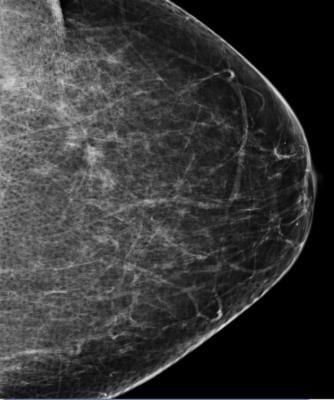
June 5, 2015 - Women aged 50-69 years who attend mammography screening reduce their risk of dying from breast cancer by 40 percent compared to women who are not screened, according to a major international review. The review covered the latest evidence on breast cancer screening.
Overall, women who are invited to attend mammography screening have a 23 percent risk reduction in breast cancer death (owing to some attending and some not), compared with women not invited by routine screening programmes.
In the U.K., this relative risk translates to around eight deaths prevented per 1,000 women regularly attending screening, and five deaths prevented per 1,000 women invited to screening.
Stephen Duffy, professor of cancer screening at Queen Mary University of London, and experts from 16 countries assessed the positive and negative impact of different breast cancer screening methods based on a comprehensive analysis of evidence from 11 randomized controlled trials and 40 high-quality observational studies.
The latest findings, published in the New England Journal of Medicine, were coordinated by the International Agency for Research in Cancer (IARC), the World Health Organization's specialized cancer agency; the data will contribute to an update of the IARC Handbook on breast cancer screening, last published in 2002.
The findings look at breast cancer screening on a global level and therefore take into account routine screening programs (where all women of a certain age are invited to attend) and opportunistic screening services (which operate in countries without a set program).
Commenting on the findings, Duffy said: "This important analysis will hopefully reassure women around the world that breast screening with mammography saves lives. The evidence proves breast screening is a vital tool in increasing early diagnosis of breast cancer and therefore reducing the number of deaths.
"In the U.K. we are extremely fortunate to have the NHS Breast Screening Program where all women aged 50-70 years are invited to attend. Women invited to this service can be reassured the program is endorsed by internationally respected organizations and experts."
The report confirms previous findings that women aged 50-69 years benefit most from breast cancer screening. However, several studies also showed a substantial reduction in risk of death from breast cancer by inviting women aged 70-74 years for screening - a shift away from previous consensus. Only limited evidence was identified in favor of screening women in their 40s.
Duffy continued: "Despite evidence that mammography screening is effective, we still need to carry out further research on alternative screening methods, such as the promising 'digital breast tomosynthesis'; a newly developed form of 3-D imaging which could potentially improve the accuracy of mammography in coping with more dense breast tissue.
"It is also vital we continue researching the most effective ways of screening women at high risk of breast cancer due to family history or genetic status. We need further evidence to fine-tune services offered to high risk women in terms of different screening methods, from an earlier age and possibly at shorter intervals."
The purpose of breast screening is to diagnose women with breast cancer earlier, therefore improving prognosis and reducing the number of late-stage cases and deaths. However, concerns have been raised over the negative impact of mammography screening - notably, false-positive results, overdiagnosis and possibly radiation-induced cancer. This new review builds upon previous evidence which suggests the potential benefits of breast screening outweigh the risks.
For more information: www.qmul.ac.uk
 October 09, 2026