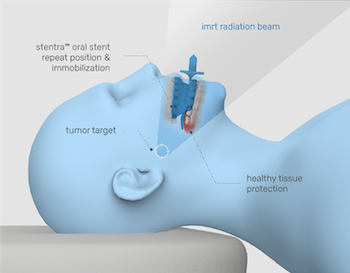
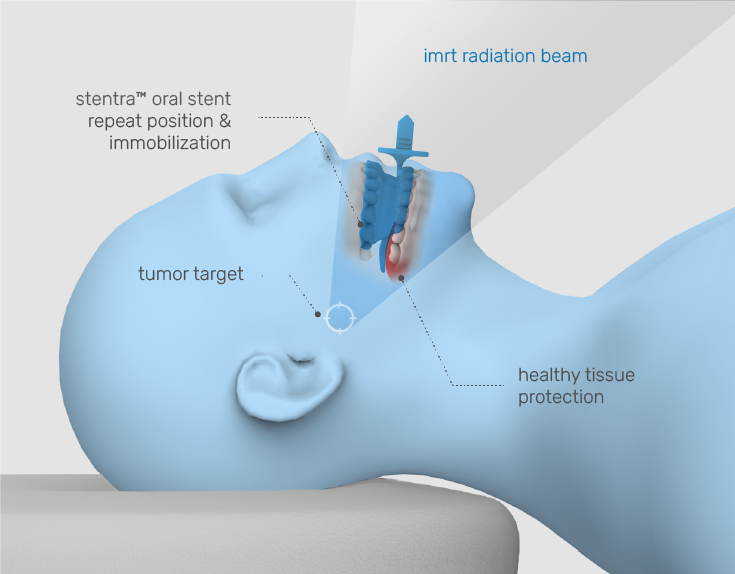
Stentra is a fully patient-specific intraoral device for head and neck radiation therapy. Custom-designed from a 15-minute scan. Image: Kallisio
Radiation oncology teams can now shape a dose to within millimeters, but the patient on the table still has to match the planning scan. Across a six- to seven-week head and neck treatment course, tumor shrinkage and soft-tissue shifts can make that harder. Reproducible positioning is becoming a quality issue, though it’s not always tracked that way.
Less Room for Setup Error
Intensity-Modulated Radiation Therapy (IMRT) and Volumetric Modulated Arc Therapy (VMAT) wrap the dose tightly around the target, but that precision cuts both ways. A Cancer Medicine review found that sharp dose gradients make anatomical change more consequential than in conventional treatment, especially near critical structures.
“The tighter the plan, the less room there is for the patient to be off,” says Rajan Patel, founder and CEO of Kallisio, a Baltimore-based company that manufactures patient-specific intraoral positioning devices. “Bigger margins used to soak up setup error. As margins shrink, that cushion goes away.”
For example, Patel sees a weak point inside the mouth. A thermoplastic mask holds the head, but the tongue, lips, cheeks, and soft palate can still move. “Cone-beam CT can show you the tongue moved,” he explains. “It can’t put it back.”
Addressing Shifting Patient Anatomy
The patient changes along the way, too. Tumors shrink, weight drops and swelling can fluctuate during treatment. A 2023 systematic review in Acta Oncologica found that anatomical change can pull a delivered dose away from the plan. Adaptive radiotherapy can help correct course, but it adds a significant workload.
“Adaptive planning helps,” Patel says. “But it costs physics and dosimetry time, and it reacts after the change has happened.” Holding the same position on day 30 as on day one can become harder as mucositis and weight loss set in.
Positioning Variability
A dose that drifts into healthy tissue can reach the clinic. At Mayo Clinic, Robert Foote, MD, and colleagues studied 196 patients whose radiation fields included the oral cavity. A higher mean oral cavity dose predicted opioid use and hospitalization during treatment and in the 30 days after.
A Roswell Park Comprehensive Cancer Center study of 657 patients receiving definitive chemoradiation found that 29% had an unplanned hospitalization. Hospitalized patients had about twice the adjusted risk of death.
Patel ties that chain back to setup. “The difference between tight and loose shows up as mouth pain, opioids, and admissions,” he says. “Not just as a number on a QA report.” Still, no head-to-head study compares tight-tolerance centers with loose ones, so the case rests on linked evidence rather than a single trial.
Creating a Quality Metric
Some tools already exist. At a center affiliated with Army Medical University in China, researchers randomly assigned 60 patients with oropharyngeal cancer to a 3D-printed oral stent, a simple glass bottle, or no stent. The printed-stent group showed lower mean positioning errors on some axes and reduced doses to certain oral structures, though the authors called for larger studies to confirm the findings.
Measurement matters, too. A 2023 study of 20 patients with tongue cancer used daily kilovoltage cone-beam CT to measure six-degree interfraction setup errors and estimate their effects on targets and organs at risk.
Patel argues the bigger gap is ownership. Most centers log image-guidance shifts, he says, but few trend them by patient, disease site, or device. “Machine QA has named owners and defined tolerances,” he says. “Patient reproducibility usually has neither.”
Patel frames quality around three questions: Did the machine deliver the plan? Was the anatomy where the plan assumed? What happened to the patient? “Most programs measure the first and the last,” he says. “The middle one is the gap.”
A Position Worth Holding
Imaging and planning will likely keep getting sharper, but the patient still has to land in the same place throughout treatment. Centers that trend setup data, assign ownership, and connect shifts to toxicity can narrow the gap between a planned and delivered dose. For head and neck patients, that gap can show up as pain, opioid prescriptions, and hospital stays.
References
-
Foote RL, Harmsen WS, Amundson AC, et al. Mean oral cavity organ-at-risk dose predicts opioid use and hospitalization during radiotherapy for patients with head and neck tumors. Cancers. 2024;16(2):349. https://pubmed.ncbi.nlm.nih.gov/38254837/
-
Ma SJ, Virk J, Schrand TV, et al. Association of percutaneous endoscopic gastrostomy (PEG) tube placement with unplanned hospitalization for head and neck cancer. Cancers. 2025;17(13):2066. https://pubmed.ncbi.nlm.nih.gov/40647369/
-
Lindegaard AM, Håkansson K, Bernsdorf M, et al. A systematic review on clinical adaptive radiotherapy for head and neck cancer. Acta Oncol. 2023;62(11):1360-1368. https://pubmed.ncbi.nlm.nih.gov/37560990/
-
Ma J, Chen Z, Liu S, et al. The application of 3D-printed oral stents in intensity-modulated radiotherapy for oropharyngeal cancer and their dosimetric effect on organs at risk. Eur J Med Res. 2023;28:367. https://pubmed.ncbi.nlm.nih.gov/37736754/
-
Interfraction 6D setup errors in tongue cancer IMRT and VMAT using daily kV-CBCT. Rep Pract Oncol Radiother. 2023;28(2):224-240. doi:10.5603/RPOR.a2023.0020 https://pubmed.ncbi.nlm.nih.gov/37456705/
-
Adaptive radiotherapy for head and neck cancer: pitfalls and possibilities from the radiation oncologist’s point of view. Cancer Med. PMC11036082. https://pubmed.ncbi.nlm.nih.gov/38650546/
-
Patel R. Q&A responses to Imaging Technology News. October 2026.
 July 09, 2024