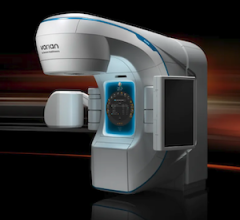
September 27, 2013 — Early-stage breast cancer patients who receive external beam therapy (XRT) are not at higher risk for serious long-term side effects in the chest area, including increase in deaths from cardiac disease and secondary malignancies, according to research presented at the American Society for Radiation Oncology’s (ASTRO’s) 55th Annual Meeting.
The study utilized patient information from the National Cancer Institute’s Surveillance, Epidemiology and End Results (SEER) database. It evaluated women identified as having primary Stage T1aN0 breast cancer (tumor of 5mm or less that has not spread to the lymph nodes), who received surgery, with or without post-operative radiation therapy, between 1990 and 1997. The analysis was done to determine if XRT was associated with increased mortality due to breast cancer, secondary cancer in the chest area or cardiac conditions for these patients; only patients with breast cancer (BC) identified as the first malignancy were included. The women had a median age of 55-59 and were divided into two groups: 2,397 who received XRT after surgery, and 2,988 who did not receive XRT after surgery.
Cause of death (COD) codes were used to identify cardiac mortality, breast cancer mortality, and deaths from secondary chest cancers in order to assess overall survival (OS), breast cancer survival (BCS), second-tumor specific survival and cardiac-cause specific survival (CCS), and then compared between the XRT and non-XRT groups. The incidence of mortality was compared between the XRT and non-XRT groups utilizing the Chi-Square test; and, the relative risk (RR) and associated 95 percent confidence interval (CI) were calculated. Kaplan-Meier survival analysis and log-rank test were performed to assess OS, BCS, second-tumor specific survival and CCS.
At 10 years post-treatment, OS rates were 91.6 percent for the XRT patients and 87 percent for the non-XRT group; BCS rates were 97 percent for the XRT patients and 95.7 percent for the non-XRT group; and CCS was 96.7 percent for the XRT patients and 92.7 percent for the non-XRT group.
Analysis of the data further demonstrates that, with a median follow up of 14 years, there was no statistically significant difference in deaths from subsequent non-breast cancers in the chest area, the majority of which were lung cancers. The number of deaths from cardiac causes was not significantly higher for those patients treated with XRT for left-sided breast cancer, compared to those with right-sided breast cancer among the patient sample and time period reviewed. More women from the non-XRT group died from all causes, including cardiac causes, suggesting that those patients had worse general health conditions than the women who received radiation therapy.
“Breast conserving therapy, consisting of lumpectomy and XRT, has been an excellent approach to early breast cancer treatment, offering equivalent disease control and better cosmetic results compared to mastectomy as demonstrated by multiple randomized controlled trials in the past,” said Jason Ye, M.D., the study’s presenting author and a second-year resident in radiation oncology at Weill Cornell Medical College in New York City. “Our study’s results suggest that serious long-term side effects of radiation therapy, such as increase in deaths from cardiac disease and secondary malignancies, are rare. Radiation therapy is an integral part of early stage breast cancer treatment for those who choose to have a lumpectomy instead of a mastectomy, with its benefits likely far outweighing the potential risks in majority of the cases. The field of radiation oncology is rapidly changing, with new technology constantly being introduced that may reduce these risks further. Continued long term follow up and additional studies are needed to monitor for potential long term side effects.”
For more information: www.astro.org

 October 09, 2026