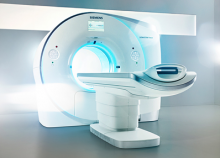
DV24.0 Continuum Pak Silent Scan

Providing faster body MR imaging without jeopardizing quality can have a significant impact on patient satisfaction and MR workflow efficiency — while still providing important clinical information.

One of the simplest ways to make the exam faster and more acceptable to patients is to shorten the breath hold. That’s precisely what technologists and radiologists at Mt. Sinai are doing with Caipirinha, a unique parallel imaging acquisition technique that can cut breath holds for 3DT1 exams in half without impacting image resolution, coverage, or contrast.

The result has been dramatic. “Moving from about 20 seconds to 8 seconds is a major change in breath hold. It’s important for people who are very sick, like chronic liver disease patients, or for pediatric patients,” said Bachir Taouli, MD, professor of radiology at Mt. Sinai.

See the clinical difference for yourself in Mt. Sinai’s body MR images.


With a new microbeam emitter developed at the University of North Carolina at Chapel Hill UNC, microbeam technology has been scaled down, opening the doors for clinical research.


Breast cancer is the most common cancer in women worldwide, both in the developed and the developing world. Early detection of breast cancer, either by hand or by using mammography screening, is one of the best methods to improve survival rate.


Intelerad Medical Systems, a medical imaging picture archiving and communication system (PACS), radiology information system (RIS) and workflow solutions company, announced that the United States Department of Veterans Affairs (VA) has selected IntelePACS as the PACS for their National Teleradiology Program (NTP).

For patients who fail to respond to current first-line and second-line treatments for colorectal cancer liver metastases (also known as salvage patients), radioembolization with Y-90 microspheres could extend survival according to new research published in the November issue of The Journal of Nuclear Medicine.

Many healthcare systems are finding their general PACS and cardiology PACS are both aging and their image storage is reaching capacity. How do the diagnostic imaging departments address the needs of their cardiologists and radiologists?

Hospital La Fe, a clinical collaborator of Nucletron, an Elekta company, is nearing the conclusion of the enrollment phase of a clinical study with the Esteya electronic brachytherapy system for treating skin cancer.

A rural community hospital located in northeast Oregon, Good Shepherd Medical Center is a busy 49-bed facility that serves the town of Hermiston and its surrounding communities.

Given their rural location, Good Shepherd is a heavy transfer facility located near the junction of two state highways and often the first stop for trauma patients from traffic accidents in the area. These patients, along with those who require specialized treatment or care for extended periods, are often transferred to larger facilities in Washington or Portland. For this reason, Good Shepherd required a solution that easily transferred images across multiple locations. With its Web-based, distributed architecture, Intelerad was able to meet the needs of the hospital, deploying its IntelePACS and InteleViewer solutions back in 2002.

With only one radiologist on staff at a time, diagnostic imaging staff must work as efficiently as possible to ensure patients receive the highest levels of care. To enhance productivity, Good Shepherd integrated IntelePACS with PowerScribe 360, Nuance’s dynamic radiology reporting and communication platform.

“The integration has dramatically cut down our turnaround time,” said Ann Richards, Good Shepherd’s HIS analyst and PACS administrator. “Whereas it formerly took anywhere between 12 to 24 hours to deliver a report, radiologists’ average turnaround time over the course of a week has been five and a half minutes. It’s been a dramatic reduction.”

Subscribe Now