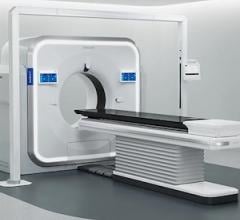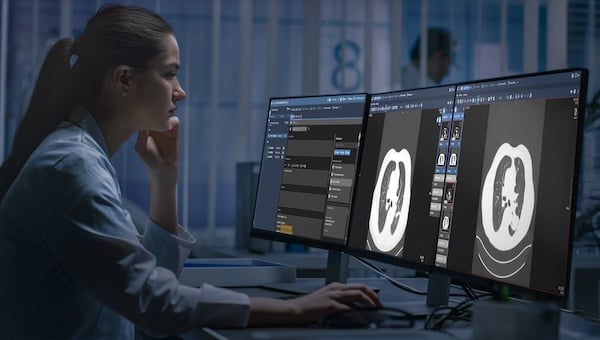
An enterprise imaging system can converge systems into a single, secure, standards-based platform, deployable in the cloud, hybrid, or on premises. (All photos: AGFA Healthcare)
For radiology departments, the imbalance between surging imaging volume and a shortage of trained radiologists is taking its toll. One recent study shows that higher clinical workloads led to a 61% increase in radiologist practice turnover from 2013 to 2022.1 And with imaging utilization expected to grow by 16.9% to 26.9% by 2055, there’s little relief in sight.2
To keep pace, medical centers and radiology groups are migrating from legacy picture archiving and communication systems (PACS) to enterprise imaging platforms, giving radiologists a single pane of glass through which to view images and collaborate.
“Traditional PACS was never built for enterprise scale,” explains Rob Mayer, chief product officer, AGFA HealthCare.
AGFA HealthCare’s Enterprise Imaging platform can be deployed on premises, hybrid or in the cloud, but almost every request for proposal the company sees in the U.S. today asks for a cloud solution first, Mayer says. He notes the robust merger-and-acquisition activity among health systems as a key driver for that shift.
ENTERPRISE IMAGING IN ACTION
Northern Light Health in Maine saw the need to upgrade its imaging infrastructure four years ago. At the time, the system’s radiologists had to navigate different PACS interfaces for cardiology and radiology studies, then switch to a third application to view PET scans. This reality hindered collaboration, especially between radiologists and cardiologists.
“We couldn’t work together on cardiology studies that required radiology overreads,” says Yeang Chng, MD, PhD, informatics champion at Northern Light Health. “Going to an enterprise imaging platform was our way of solving that.”
The organization chose to migrate 10 years’ worth of studies from its legacy systems onto the AGFA platform, which went smoothly. “We actually finished several weeks ahead of schedule,” Dr. Chng says. “I would say 99.99% of the studies we wanted were immediately available.”

IMPACTS ON PATIENT CARE
The move to an imaging platform has benefited radiologists, referring providers and patients. “The efficiency increase is unbelievable,” says Dr. Chng, who credits the platform with helping Northern Light accommodate approximately 700,000 radiology studies annually across a wide rural population.
Reliability, too, is impressive. “In all the time we’ve used AGFA, we’ve had zero unscheduled downtime,” he says.
Radiologists, cardiologists, oncologists and other specialists can access all of a patient’s images on the platform, leading to increased diagnostic confidence. Highlighting this benefit, Dr. Chng explains a scenario where he sees a nodule in a chest CT scan, and the only prior study is a cardiac CT scan from two years earlier.
“In the past, that image wouldn’t have been available to me, and I would’ve had to order follow-up imaging to rule out cancer,” he says. “Today, I can go back to that cardiac CT and see that the nodule was there two years ago and that it’s benign. That reduces the patient’s anxiety and saves them from the additional cost of more imaging. It’s better, more efficient care.”
INTEGRATING MORE SPECIALTIES AND AI

Mayer sees enterprise imaging platforms growing in sophistication over the next 12 to 18 months through adding specialties and AI capabilities.
From an AI perspective, AGFA HealthCare is advancing its strategy toward an Imaging Intelligence Hub: a platform where Pixel AI, generative AI, and agentic workflow intelligence can come together to support smarter, more connected imaging workflows. This strategy is built on three complementary pillars: partnering with leading AI vendors where they bring proven clinical value; embedding platform-native AI capabilities where they strengthen the Enterprise Imaging experience; and enabling AI inputs from any vendor so customers can orchestrate innovation on their own terms. For example, Northern Light leverages RapidAI, embedded within AGFA HealthCare’s platform, to support enhanced detection of intracranial hemorrhage on outpatient CT scans.
More broadly, AGFA HealthCare’s direction is to move beyond individual algorithms toward an intelligence layer that can help detect, prioritize, summarize, guide, and eventually act across the imaging workflow.
“Our ultimate goal,” Mayer says, “is to be the most AI-friendly enterprise imaging platform in the market.”
References
-
Parikh JR, Drake AR, Rula EY, Golding E, Christensen EW. Radiologist Turnover in the United States. J Am Coll Radiol. Published online Feb. 25, 2026. doi:10.1016/j.jacr.2026.01.009
-
Christensen EW, Drake AR, Parikh JR, Rubin EM, Rula EY. Projected US Imaging Utilization, 2025 to 2055. J Am Coll Radiol. 2025;22(2):151-158. doi:10.1016/j.jacr.2024.10.017
 October 02, 2026