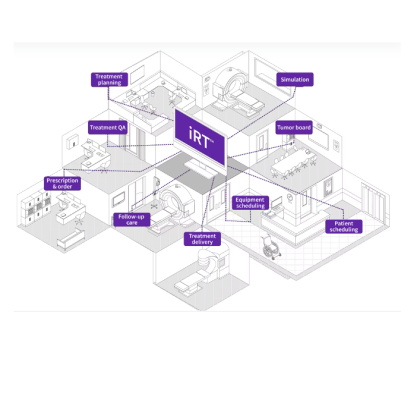
Sept. 25, 2025 — GE HealthCare has announced updates to Intelligent Radiation Therapy (iRT), a new version of the company’s software solution for radiation therapy workflow management, designed to reduce the time it takes for patients to go from diagnosis to treatment. The iRT solution is AI-supported by GE HealthCare and third-party applications, and the latest features bring enhanced connectivity to the systems radiation oncology departments use most and use insights to improve departmental efficiency.
The company also has unveiled a new capability for theranostics that manages these complex workflows throughout the patient treatment journey, extending its expertise in radiation therapy workflows to this evolving field. The latest updates will be showcased at the American Society for Radiation Oncology (ASTRO) 2025 Annual Meeting in San Francisco (Sept. 28 – Oct. 1).
Improving Workflow Efficiencies
Radiation therapy is a treatment nearly 60% of cancer patients[2] receive, yet it can take up to 30 days[3] just to begin. Radiation oncology workflows are complex, and teams work across many systems, but these systems rarely connect, contributing to possible treatment delays and errors. As a result, staff often re-enter the same data in multiple places, wasting time and increasing the risk of errors. Simple tasks, like importing treatment data, can take up to 17 manual steps. These inefficiencies can lead to potential inaccuracies that result in delayed treatments for patients and potentially poor outcomes.[4] Today, hospitals worldwide are adopting iRT’s vendor-neutral solution that manages data between systems to streamline the complex radiation therapy workflow, designed to enable a shorter timeline to treatment for patients and reduce workload for clinicians. Early adopters of iRT to date have seen the time reduced from seven days to seven minutes[1] to go from simulation to treatment planning with integration of iRT and RayStation by RaySearch Laboratories. iRT delivers new features including:
- Analytics reporting: gives department administrators a holistic view to analyze efficiency, identify operational gaps, and document trends.
- Staff scheduler: accounts for out of office schedules using an intelligent resource management tool to optimize staffing, helping to reduce treatment delays.
- Auto-segmentation of organs at risk by MR Contour DL[5]: uses AI to outline sensitive organs near the tumor so they can be protected during treatment, a process that was previously entirely manual. iRT has enabled connection with a GE HealthCare developed AI-model, MR Contour DL, for MR imaging and is interoperable with third-party devices MVision Contour+ for CT imaging, in addition to current interaction with MIM Contour ProtégéAI+™.
- VERT virtual reality app from Vertual Ltd: connects to a third-party application that allows clinicians to walk patients through a simulation of the treatment process, helping reduce the fear of the unknown, and uses advanced 3D models to enhance staff training.
- Greater connectivity: integrates with the systems radiation oncology departments use most, with a vendor-neutral approach, including electronic medical records (EMR), oncology information systems (OIS), and other fast healthcare interoperability resources (FHIR).
“We are transforming the radiation therapy experience for patients and clinicians with our Intelligent Radiation Therapy solution, helping clinicians move from diagnosis to treatment in minutes, not days,” says Ben Newton, GE HealthCare’s general manager for Oncology Solutions. “We’re thrilled to share the latest features in iRT designed to bring greater precision, efficiency, and personalization to cancer care.”
iRT for Theranostics
Theranostics is a branch of nuclear medicine that uses molecular imaging and targeted radionuclide therapies aimed at the same biological target to treat cancer in the body and is gaining interest for advanced-stage cancer outcomes. These therapeutic and diagnostic technologies work together to enable a personalized, highly precise, patient-centric approach to medical diagnosis and treatment. Today, many steps of the workflow are manual, which is further complicated by the significant communication and triage needed to facilitate a patient’s treatment plan, leading to wasted doses of medication or delayed treatments.[6]
The iRT features for theranostics aim to bring a unified view to this highly complex treatment. It integrates with EMRs and OIS to give a holistic view of the patient journey and guide clinicians step-by-step through patient intake, patient assessment, scheduling, medication dosing, dosimetry, and clinical reviews.
“Miami Cancer Institute is pleased to collaborate with GE HealthCare on iRT, an innovative solution designed to address the rapidly evolving landscape of radiopharmaceuticals,” said Dr. Ranjini Tolakanahalli, director of photon physics at Miami Cancer Institute, part of Baptist Health South Florida. “Together, we are developing a solution where clinical priorities shape design, ensuring future solutions are informed by real-world medical expertise.”
Click here to learn more about GE HealthCare’s Intelligent Radiation Therapy (iRT).
- Based on two InstaPlan (iRT + RayStation by RaySearch) clinical studies in Europe based on a total of 20 patients. Any results achieved using InstaPlan may vary based on differences in workflows, patient populations or other factors.
- American Society for Radiation Oncology. Radiation Oncology Case Rate (ROCR) Report. June 26, 2023. https://www.astro.org/ASTRO/media/ASTRO/Advocacy/PDFs/ROCRReport.pdf.
- https://research.gehealthcare.com/across-the-enterprise/4-benefits-of-o…
- Gopan, Olga, Jing Zeng, Avrey Novak, Matthew Nyflot, and Eric Ford. 2016. “The Effectiveness of Pretreatment Physics Plan Review for Detecting Errors in Radiation Therapy.” Journal of Applied Clinical Medical Physics 17 (5): 16–31. https://doi.org/10.1118/1.4961010.[1](https://aapm.onlinelibrary.wiley.com/doi/pdf/10.1118/1.4961010)
- Not available in all regions.
- GE HealthCare internal data. Results may vary. The statements by GE HealthCare customers are based on their opinions and results achieved in their unique setting. Since many variables exist (i.e., size, case mix, etc.), there can be no guarantee that other customers will achieve the same results.
 October 05, 2026