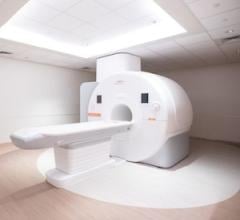
June 26, 2025 — Siemens Healthineers has received Food and Drug Administration clearance for the Magnetom Flow.Ace, its first 1.5 tesla (T) platform for magnetic resonance (MR) imaging with a closed helium circuit and no quench pipe, significantly reducing reliance on helium. The system, which has a 60 cm bore, is also the first Siemens Healthineers MR scanner to be marketed to the veterinary radiology community as well as for general radiology
It covers the entire range of MR applications, with image reconstruction based on artificial intelligence (AI) to enable shorter scan times with improved image quality. Its wide range of contour and dedicated MR coils can be used for a variety of human anatomies, and coils are also available for veterinary applications. The Magnetom Flow.Ace is the second virtually helium-free MR platform from Siemens Healthineers, following the 0.55T Magnetom Free platform.
“With the FDA clearance of the Magnetom Flow.Ace, Siemens Healthineers is pleased to introduce our first helium-free 1.5T MR scanner,” said Katie Grant, head of Magnetic Resonance at Siemens Healthineers North America. “This 60 cm bore system is also available for veterinarians, with the same intelligent, high-end technology that we’ve offered to the general imaging community, at a highly attractive total cost of ownership.”
The Magnetom Flow.Ace requires only 0.7 liters of liquid helium for cooling, compared with conventional MRI scanners, which typically require over 1,000 liters. This reduced helium requirement is due to the magnet’s DryCool¹ technology, which can lower costs and save resources by dramatically reducing a dependency on helium refills. The system design also eliminates the need for a quench pipe, which was required previously to safely allow large amounts of gaseous helium to escape directly into the atmosphere during an emergency shutdown. This lack of a quench pipe, combined with the scanner’s compact size, can reduce installation requirements and costs compared with those of other 1.5T MR scanners.
The Magnetom Flow.Ace also reduces annual energy consumption by more than 30% compared with the company’s previous generation of MR scanners.² The Eco Power Mode feature automatically deactivates energy-intensive components when they are not needed.
The scanner uses AI to support automated workflows as well as improved image quality and shorter exam times. Deep Resolve image reconstruction technology enables accelerated image acquisition, removes noise, and improves the sharpness of small structures.
The Magnetom Flow.Ace has features that are particularly beneficial when imaging animals. Its animal-friendly, high-density contour coils, which are available in three sizes, are flexible and adaptable to different anatomies. These coils contain an integrated BioMatrix Position Sensor that enables automated patient positioning for potentially faster exam setup. A full portfolio of dedicated imaging coils is also available, including coils for the brain and spine.
¹ The Magnetom Flow.Ace is equipped with Dry Cool technology, which requires only 0.7 liters of liquid helium for magnet cooling over the lifetime of the device.
² Data on file.

 October 07, 2026