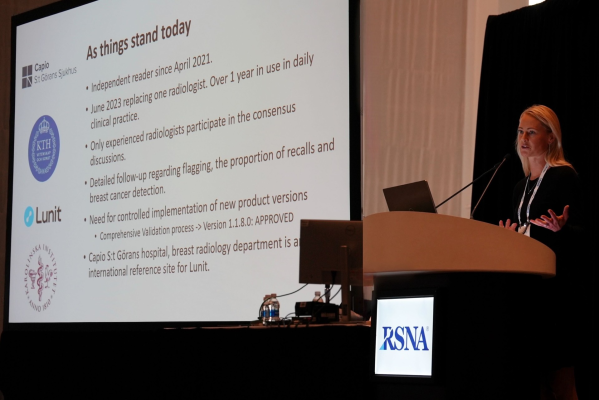
Dr. Karin Dembrower, senior breast radiologist at Capio S:t Göran Hospital, presents findings on the integration of AI in breast cancer screening during an RSNA 2024 session on Dece. 1, 2024. (Photo: Lunit)
Dec. 2, 2024 — Lunit recently unveiled follow-up findings from the ScreenTrustCAD trial. This study, conducted at Capio S:t Göran Hospital in Sweden, reinforces the real-world impact of Lunit INSIGHT MMG, which has successfully replaced one of the two human readers in the hospital’s double-reading breast cancer screening protocol.
The announcement was made at the Radiological Society of North America (RSNA) 2024 Annual Meeting in Chicago.
The original ScreenTrustCAD trial (2021–2022), published in The Lancet Digital Health, was the first prospective interventional study to demonstrate that AI could match or even surpass traditional two-radiologist systems. Building on these findings, the hospital fully integrated AI in mid-2023 and became the first in the world to implement AI as an independent reader, fully replacing one radiologist. The new analysis compares screening performance before and after AI adoption, offering real-world validation of Lunit INSIGHT MMG’s clinical and operational benefits.
Efficiency Gains and Enhanced Screening Metrics
The follow-up study analyzed screening metrics from two nine-month periods: July 2018–March 2019 (pre-AI/pre-COVID) and July 2023–March 2024 (post-AI implementation).
Key findings include:
- 11% Decrease in Recall Rates: Recall rates dropped from 2.8% to 2.5%, minimizing unnecessary follow-ups for patients.
- Fewer False Positives: The rate of false positives decreased significantly from 89.6% to 78.0%, reflecting a notable improvement in screening accuracy.
- Improved Positive Predictive Values (PPV): The PPV for recalls increased to 22.1% with AI, compared to 16.9% without AI, indicating fewer unnecessary recalls and a more efficient screening process.
- Increased Cancer Detection Rates: Cancer detection rates increased by 15%, rising from 4.8 (traditional double reading) to 5.5 per 1,000 screened (with AI).
- Reduced Overall Reading Time: Reading time decreased by over 36%, enabling radiologists to allocate more time to complex cases and other critical tasks.
These findings demonstrate AI’s ability to enhance diagnostic accuracy and significantly improve screening efficiency.
AI Integration in Breast Screening
The adoption of Lunit INSIGHT MMG at Capio S:t Göran Hospital marks a global milestone in AI-driven healthcare. By replacing one human reader, the AI system addresses the growing radiologist shortage while maintaining the rigor of double-reading protocols. Additionally, it reduces recall rates, sparing more women the stress and anxiety of a potential cancer diagnosis.
“AI has become an indispensable part of our screening program, and these results showcase its potential for broader adoption," said Dr. Karin Dembrower, senior breast radiologist at Capio S:t Göran Hospital and study presenter. "By replacing one radiologist, we’ve reduced workloads, improved cancer detection rates, and decreased unnecessary recalls. This shift has eliminated overtime on evenings and weekends, allowing radiologists to focus on complex cases — the work we are trained for. For patients, it means faster and more accurate care. Previously, the waiting time for a clinical mammogram was five to six weeks. Now, with AI, it’s down to zero.”
“This follow-up to the ScreenTrustCAD trial demonstrates the transformative potential of Lunit INSIGHT MMG in real-world clinical practice," said Brandon Suh, CEO of Lunit. "By reducing reading time by 36% while improving cancer detection rates and screening efficiency, we are proving that AI is not just a tool but a critical partner in addressing global challenges like radiologist shortages and the growing demand for efficient cancer care. As AI continues to reshape radiology, we remain committed to driving innovations that empower clinicians, optimize patient outcomes, and redefine the future of breast cancer screening.”
You can learn more at lunit.io.
 October 02, 2026