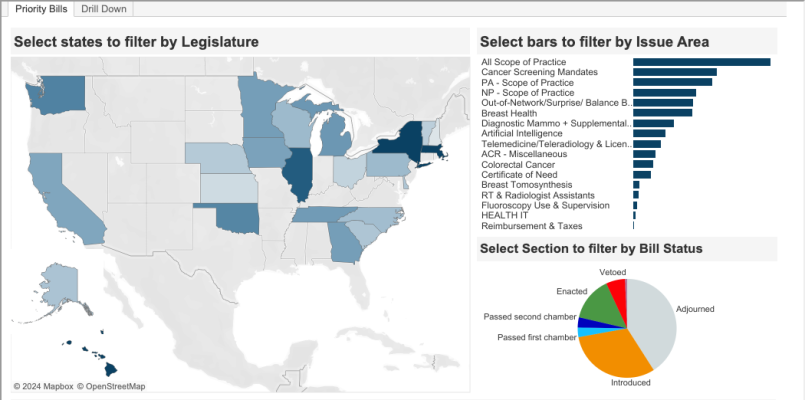
June 24, 2024 — Legislative efforts across numerous states in 2024 focused on the integration of artificial intelligence (AI) in healthcare, reflecting several trends and priorities. Many states are proposing regulatory frameworks that include the formation of workgroups, committees and boards to study and oversee AI implementation, ensuring ethical standards and data privacy are maintained.
Legislation directed at preventing algorithmic discrimination in healthcare settings is becoming prevalent, aiming to protect patients from biases in AI-driven decision-making processes. Various bills targeted utilization management in health insurance, with the goal of ensuring ethical use and safeguarding patient rights. The state legislatures are also considering measures related to patient consent and disclosure, seeking to mandate transparency in development and use of AI applications.
Notable legislative efforts include:
California
CA Assembly Bill 3030 , Health Care Services: Artificial Intelligence. As written, the bill would mandate that any health facility, clinic, physician’s office or group practice office using generative AI to generate patient communications must include a disclaimer notifying the patient that the communication was AI generated and provide clear instructions for contacting a human healthcare provider. The bill passed the Assembly and is currently in the Senate.
CA Senate Bill (SB) 1120 . The proposed measure stipulates that a denial, delay, or modification of healthcare services based on medical necessity shall be made by a licensed physician or other healthcare provider competent to evaluate the specific clinical issues involved in the healthcare services requested by the provider and with the same or similar specialty as the requesting provider. This bill would require algorithms, AI and other software tools used for utilization review or utilization management decisions of a healthcare service plan to comply with specified requirements, including that they be fairly and equitably applied. The bill passed the Senate and is currently in the Assembly.
Colorado
CO SB24-205 . The bill, signed by Gov. Jared Polis in May, requires developers of high-risk AI systems to use reasonable care to avoid algorithmic discrimination. Compliance provisions include disclosing specified information about the high-risk system to deployers, providing necessary documentation for impact assessments, publicly summarizing the types of systems developed, and reporting risks of algorithmic discrimination to the attorney general and deployers within 90 days of discovery.
Georgia
GA Senate Resolution 476 . The resolution created the Senate Study Committee on Artificial Intelligence to explore the potential and implications of AI technology. Recognizing AI's capacity to spur innovation and transform sectors such as healthcare, the committee aims to address both the opportunities and challenges presented by AI advancements. The committee will focus on establishing ethical standards to ensure the technology preserves the dignity, autonomy and self-determination of individuals.
Illinois
IL House Bill (HB) 5116 , Automated Decision Tools Act. The bill would mandate that, by Jan. 1, 2026, and annually thereafter, deployers of automated decision tools must conduct an impact assessment on any such tools they use, design, code or produce. Additionally, the act would require any individual subject to a consequential decision made or significantly influenced by an automated decision tool be notified of its use and provided with specified information. The bill was referred to the House Rules Committee.
Oregon
OR HB 4153 . The enacted bill established a Task Force on Artificial Intelligence to examine and identify terms and definitions related to AI for potential legislative use. The task force is required to report its findings and recommendations to the interim committee of the Legislative Assembly related to information management and technology by Dec. 1.
Rhode Island
RI HB 8073 . The bill would mandate coverage for the use of AI technology for analysis of breast tissue diagnostic imaging if the imaging and review generated by AI is independently reviewed and approved of by a physician qualified to read and interpret breast tissue diagnostic imaging.
Utah
UT SB 149 . Artificial Intelligence Policy Act. The act, signed by Gov. Spencer Cox, creates the Office of Artificial Intelligence Policy and a regulatory AI analysis program. Among other provisions, it requires that a person who uses, prompts or otherwise causes generative AI to interact with a person shall clearly and conspicuously disclose that the person is interacting with generative AI and not a human.
Washington
WA SB 5838 . The enacted bill created a task force to assess current uses and trends by private and public sector entities and make recommendations to the legislature regarding standards for the use and regulation of AI.
West Virginia
WV HB 5690 . The enacted bill created the West Virginia Task Force on Artificial Intelligence, tasked with recommending a definition of AI, determining the relevant state agency or agencies to develop and oversee AI policy, developing best practices for public sector uses of AI in the state, as well as recommending legislation to protect individual rights, civil liberties, and consumer data as it relates to generative AI.
ACR partners with Fiscal Note, a legislation and regulation tracking service, to provide continuous, comprehensive updates on radiology and healthcare-related legislation. To stay current on state legislative developments relevant to radiology, view the ACR policy map.
ACR always looks for members’ advocacy efforts to highlight. If you would like to highlight someone for their advocacy work, share your advocacy experience, or share pictures from your recent state advocacy day, contact Eugenia Brandt, ACR Senior Government Affairs Director, or Dillon Harp, ACR Senior Government Relations Specialist.
For more information: www.acr.org

 October 02, 2026