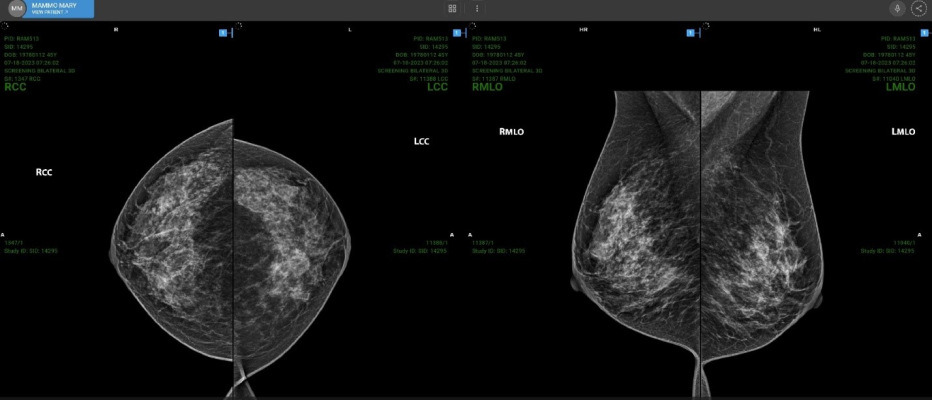
March 18, 2024 — RamSoft, a global leader in novel cloud-based RIS/PACS radiology solutions for imaging centers and teleradiology providers, has launched Progressive Loading. This unique feature of OmegaAI, RamSoft’s cloud-native radiological software built on Microsoft Azure, allows a radiologist to quickly load a large imaging study via a web browser. A radiologist can begin to read and interact with new studies with no delay; the first images load almost immediately and secondary images load progressively in the background while the radiologist interacts with the study. Because the platform is cloud-native, image loading is fast regardless of what type of network is being used, and the performance is faster than traditional cloud-based deployments and most on-premises networks.
By building its cloud-native platform using Progressive Loading, OmegaAI can deliver the first images of a 3,000-slice CT data set, for example, in one second or less over standard internet connectivity without a VPN. RamSoft recently completed an internal validation study in which images of a breast tomosynthesis test study were transferred from OmegaAI in the USA and manipulated by a radiologist in India using the OmegaAI reader within one second.
“Some radiologists are still skeptical that cloud-native radiology software accessed via a web browser on a standard Internet connection can allow them to review and analyze medical images from multiple modalities with the same ease as traditional on-premises radiology software,” said Siva Ramanathan, RamSoft’s Chief Technology Officer. “OmegaAI was purposely built as a cloud-native platform. Its cloud-native architecture enables innovative software solutions that can load large image data sets much faster than traditional cloud platforms, and faster than on-prem installations. We repeatedly see radiologists react in amazement when they realize that they are looking at large radiology images delivered via a zero-footprint reader in a web browser. As our team developed OmegaAI, we worked diligently on delivering a cloud-native radiology experience with an image presentation speed that is faster than legacy on-prem radiology software. Our implementation of Progressive Loading helps us deliver on that promise even more.”
“Medical imaging plays a vital role in healthcare. The ability to deliver large radiology images quickly and efficiently is not merely a matter of convenience but a critical necessity. It can help reduce workload burdens and enable radiologists to expedite analysis, diagnosis, and treatment, thereby helping to enhance patient care and outcomes with precision and efficacy,” said Dr. Helia Mohammadi, Chief AI and Precision Health Officer, Microsoft. “RamSoft’s integration of Microsoft Azure to accelerate healthcare innovation is a great example of how technology can be leveraged to improve provider and patient experiences.”
A key benefit of cloud-native RIS/PACS systems is the ability to deploy the platform without local servers or high-performance local computing workstations and without a VPN or high-speed networks. By integrating Azure services including Azure SQL Database, Azure Cosmos DB and Azure Blob Storage, OmegaAI also provides the highest levels of cybersecurity, HIPAA compliance, and scalability.
For more information: www.ramsoft.com

 October 08, 2026