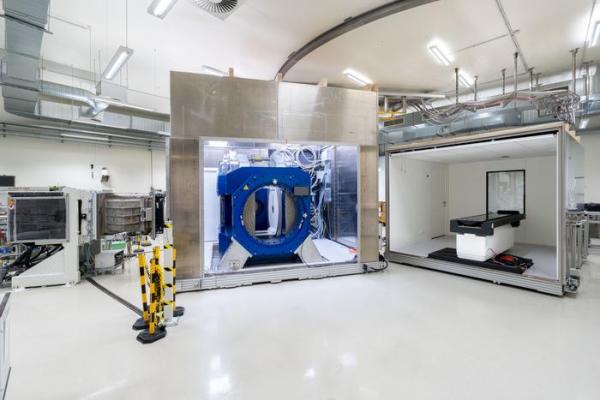
Beam line of the proton therapy system (left) with opened Aurora-PT system (i.e. in-beam MRI (middle) and patient couch (right)). Image courtesy of UKD/Kirsten Lassig
January 11, 2024 — On January 9th, 2024, a scientific prototype for MRI-guided proton therapy was inaugurated in Dresden. With this installation, experts from the fields of medicine, medical physics, biology and engineering are embarking on the scientific testing of a new form of radiotherapy for treating cancer. For the first time globally, a full-body MRI device for real-time imaging is combined with a proton therapy system in the form of a prototype. The inauguration ceremony was held at OncoRay – National Center for Radiation Research in Oncology with Saxony’s Minister-President Michael Kretschmer present. After demonstrating the technical feasibility using a compact MRI device without real-time imaging with a predecessor prototype financed by the Sächsische Aufbaubank in 2019, the Helmholtz-Zentrum Dresden-Rossendorf (HZDR) has now financed the development of a pioneering full-body MRI device with real-time imaging. The infrastructure as well as a number of the personnel are provided by the Dresden University Medical Center.
The aim of the Saxon physicians together with scientists from the HZDR and the Dresden University Medical Center is to monitor cancer patients during their radiation treatment using real-time MRI imaging and thus to significantly improve the targeting accuracy of proton therapy. A globally unique combination of a full-body MRI machine that rotates around the patient for real-time imaging and a proton therapy system was created in Dresden. Scientific operation has now begun in January 2024.
The MRI’s advantage over conventional imaging modalities is that it can visualize the tumor in higher contrast. This makes it possible to better delineate the tumor from surrounding healthy tissue and to define the volume to be irradiated more accurately. Furthermore, MRI imaging can visualize any potential changes in the shape and size of the volume to be irradiated between consecutive radiation sessions. This enables the beam application to be adjusted individually and immediately. In addition, it allows the real-time MRI imaging to visualize tumor movement during a radiation session and to synchronize it with the radiation application. The prototype that has now been installed will be the first of its kind globally to investigate the extent to which the accuracy of proton therapy can be improved with the help of full-body real-time MRI imaging.
At the OncoRay – National Center for Radiation Research in Oncology, the “Experimental MR-Integrated Proton Therapy” research group led by Prof. Aswin Hoffman has developed the new system. This was a technological challenge, as both the MRI device and the proton radiation system work with magnetic fields, which interact with one another and thus influence the quality of the imaging as well as the proton beam application. Having already demonstrated the technical feasibility of simultaneous radiation and imaging using a prior prototype, the research group can now utilize the new system for the first time worldwide to examine the extent to which it is possible to do so using real-time MRI imaging. “This new prototype with integrated full-body MRI makes it possible to visualize moving tumors using high-contrast real-time imaging. Our work aims to develop a technique to irradiate tumors only when they are hit reliably by the proton beam,” says Hoffmann. “The MRI device, which can rotate around the patient, enables us to use innovative types of patient positioning for proton therapy in both lying or in upright positions.” The prototype will be used in future studies to demonstrate the added value of this new prototype for mobile tumors in the chest, abdomen and pelvis.
The prototype has been erected in the proton therapy facility’s experimental room at OncoRay on the premises of the School of Medicine Dresden. There, an international team of researchers is working on innovative ways of treating cancer. Thanks to a large experimental room adjacent to the actual treatment room for patients, the Dresden proton therapy facility enables this unique research work to advance in an interdisciplinary team.
The prototype’s development and installation were made possible in close cooperation with international industry partners. ASG Superconductors in Genoa, Italy manufactured the MRI device, while MagnetTx Oncology Solutions in Edmonton, Canada designed the rotating gantry. Company representatives from both manufacturers were present at the launch ceremony.
Michael Kretschmer, Minister-President of Saxony: “The inauguration of this globally unique combination of an MRI machine with a proton therapy facility marks a milestone for Saxony as a center for science. It is an example of the potential and knowledge available here. At the same time, it becomes clear how we can achieve great things together through strong international collaborations. It is positive and right that the Free State of Saxony specifically supports innovative projects such as this one at the university hospital.”
Sebastian Gemkow, Saxon State Minister for Science: “In order to improve therapies in the long term and to exploit the potential of modern technology, innovative science and research are needed. If, as is the case here, different technological disciplines are able to work closely together with medical professionals, this is an enormous advantage and at the same time a great benefit. The new prototype proves that even the impossible is possible. That is something we can be proud of together.”
Prof. Michael Albrecht, University Hospital Dresden, Medical Director: “What is special about the Dresden University Medical Center is the close connection between patient care and science. We have always placed a particular focus on innovative, modern, therapeutic approaches — especially in oncology. The innovative leap that we are now making with the new prototype demonstrates that we are always at the forefront. A role we can only assume thanks to the positive collaboration with our scientific and industrial partners. This is the only way flagship projects like this are possible.”
Prof. Sebastian M. Schmidt, Helmholtz-Zentrum Dresden-Rossendorf, Scientific Director: “Radiation-based cancer research is one of the HZDR's major fields of research. We conduct research for healing. Our particular concern is to quickly set research findings into practice for the benefit of patients. We are fulfilling this aspiration precisely with the new prototype.”
Prof. Esther Troost, Dean of the School of Medicine Dresden and Director of the Clinic and Polyclinic for Radiotherapy and Radiation Oncology: “The research alliance of OncoRay – National Center for Radiation Research in Oncology – sees itself as a cross-institutional research platform for medical radiation research in Dresden with a particular focus on translational research. The prototype that has now been inaugurated fits perfectly into this special research environment. Our research goal is to improve cancer treatment through biologically individualized and technologically optimized radiotherapy. We also hope to achieve such improvement with the world's first MRI-guided proton therapy developed here.”
For more information: https://tu-dresden.de/

 October 07, 2026