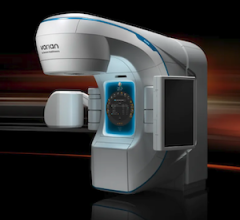
Radiation Therapy, Image courtesy of Philip Benjamin
June 29, 2022 — ProtOnART builds upon the partners’ long-standing research efforts and shared ambition that an online adaptive workflow has the potential to significantly increase the quality of cancer treatments by making better use of the conformal nature of proton radiation. Thereby, the healthy tissue-sparing dose distribution of protons will be secured along the treatment course by continuously adapting the treatment to anatomical changes or inter- and even intra-fractional motion.
The first goal for the consortium is to develop an efficient daily online adaptive proton therapy workflow demonstrated in clinical practice by the clinical partners. The end goal of ProtOnART is to develop near-real-time adaptive proton therapy, where plan adaptation is performed during or between the delivery of the proton fields and make it a clinical reality as well.
Johan Löf, founder and CEO, RaySearch, says: “Adaptive radiation therapy (ART) has been a focus area for RaySearch for more than 20 years, and it is rewarding to see that daily online ART for photon treatments finally is getting into clinical use. However, online ART may be even more important for proton therapy, which hopefully will be the next step for the community. To achieve this goal, it is pivotal that academic institutions, clinics and vendors of treatment planning systems, oncology information systems, and proton delivery systems work closely together. With the ProtOnART consortium we have managed to assemble exactly these competences.“
Charles Kumps, Chief Innovation and Development Officer of IBA: “Online adaptation is an important step towards personalized treatments in proton therapy. Defining the right tools enabling clinicians to account for morphology changes in an efficient and effective manner is only possible thanks to joint learning between the clinics and industry. We are delighted to leverage synergies between IBA and RaySearch solutions to support the ProtOnART consortium vision.“
Mechthild Krause, Director of OncoRay, underlines: “As the development of online-adaptive proton therapy is one of two main pillars of OncoRay’s strategy, we are delighted about the formation of the ProtOnART consortium, triggered also by our initiative. Our vision is to develop the technological and clinical best possible external radiation, by optimally using the physical benefits of protons also for changing anatomies. With ProtOnART, we want to bring near-real-time adaptive proton therapy into clinical reality - including a closed automated feedback loop of imaging, adaptation, treatment verification and quality assurance in real time, supported by artificial intelligence. Thereby, particularly patients with highly variable and moving tumors will benefit from the more targeted therapy.“
Edmond Sterpin, research professor on behalf of PARTICLE: “Online adaptive proton therapy has been a major research and development area of PARTICLE for several years. It potentially enables to update the treatment plan while the patient is on the treatment couch according to anatomical changes revealed by on-board imaging devices. By bringing together leading academic, clinical and industrial players, the ProtOnART consortium will ensure its effective deployment, which is an essential step for realizing the full potential of proton therapy to target tumors and spare healthy tissue with unparalleled precision. With the availability of online adaptive proton therapy, we hope to further improve the already excellent quality of the treatments delivered to our patients treated at the PARTICLE center.“
For more information: www.raysearchlabs.com

 October 07, 2026