

Sponsored Content | Blog | Enterprise Imaging | September 27, 2021
BLOG: Integrating Speech Recognition into Radiology Platforms to Improve Workflows and Patient Care
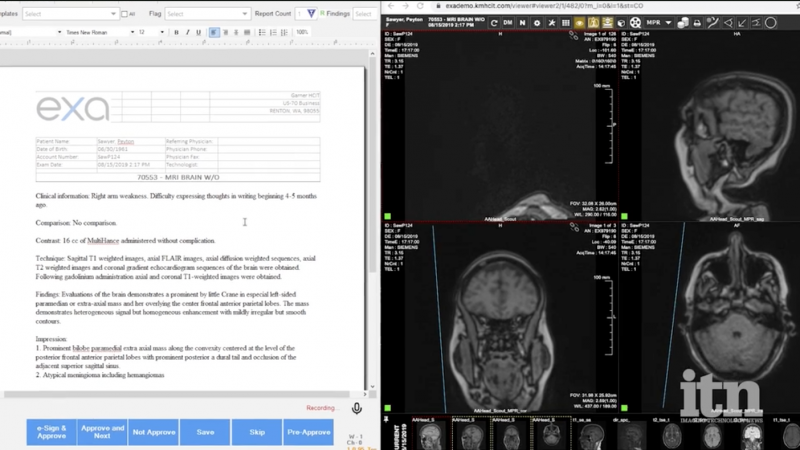
Today, enterprise imaging is breaking down silos, providing greater insight into health system and hospital operations, improving efficiencies, and ultimately, delivering better care for patients. The adoption of innovative technologies, such as speech recognition solutions in radiology platforms, is changing reporting in amazing ways, unlocking the full potential of imaging IT, improving workflows, clinical productivity and patient care.
Recently, Konica Minolta Healthcare partnered with nVoq Incorporated (nVoq), to embed its cloud-based speech recognition solution into Konica Minolta’s Exa Platform, streamlining operations, enhancing clinical productivity and making a positive impact on patient care.
A Powerful Partnership
The Exa Platform is an integrated PACS, RIS and billing solution that is scalable and adaptable to meet the needs of imaging providers, from small practices to large enterprises. It’s cloud-based and requires no workstation installation, includes a diagnostic-quality zero footprint viewer and uses server-side rendering for fast access to images anywhere. nVoq is also enterprise-ready and adaptable, bringing new functionality and power to the Exa Platform.
“Having a full, end-to-end solution is really important for providing patient care. That's our mission,” said Kevin Borden, Vice President of Product, Healthcare IT for Konica Minolta. “The objective is the reduce the time from viewing images and diagnosis to the provider receiving the report.”
According to Borden, the integration of nVoq into the Exa Platform complements Konica Minolta’s entire product portfolio of zero footprint technologies. “When you combine a cloud-based speech recognition solution with the Exa Platform, that is zero footprint with no installation or downloads, that streamlines the implementation.”
Many health systems and hospitals have evolved their radiology reporting practices from transcription services to speech recognition, Speech recognition is well known to increase efficiency in clinical workflow and to simplify accessibility.
According to Chad Hiner, Vice President of Customer Experience for nVoq, “One of the benefits of the zero footprint, cloud-based solution is that users can access it essentially anywhere from any location, remotely or in a reading room. The ability to use it over the web is important to our customers.”
Hiner added, “One of the biggest differentiators [of nVoq] is that we've always been in the cloud. We offer APIs so Konica Minolta can leverage those APIs and embed the speech recognition directly into their application. There are some other important aspects to it. You must be HIPAA compliant, which we are, and this means the data is secure in transit and at rest. We have robust medical and radiological vocabulary. The key components are the speed, the accuracy and the ease of use.”
Improving Clinical Productivity
In addition to ease of integration and accessibility, the Exa Platform plus nVoq’s API lessens the burden on healthcare IT resources which can then be allocated to other projects helping enhance clinical productivity.
“Clinical productivity is about accuracy. When a radiologist sits down to use the software, they really depend on how accurate the solution is from voice to text,” Borden said. “Most importantly, clinical productivity is all about helping the patient. By integrating nVoq’s flexible, highly accurate, HIPAA-enabled speech recognition solution into the Exa Platform, we reduce the time from the patient being imaged to diagnosis.”
Editor's note: This blog is the first in a two-part series on Leveraging Innovative Technologies to Enhance Clinical Productivity.
For related information, see Talking Trends with Konica Minolta: Integrating Speech Recognition into Radiology Platforms.
Related Content
News | Radiation Therapy
Oct. 1, 2026 — At ASTRO 2026 Elekta highlighted new data showing unprecedented long-term survival outcomes for patients ...
 October 05, 2026

News | Molecular Imaging
Sept. 22, 2026 — Blue Earth Diagnostics, a part of the Bracco Group, has announced new research examining how precision ...
September 23, 2026 
News | Artificial Intelligence
Sept. 17, 2026 — Merge has launched MergeIQ, an artificial intelligence layer that embeds practical intelligence ...
September 21, 2026 
Feature | Artificial Intelligence | Kyle Hardner
A radiologist pulls up a chest CT scan flagged for a pulmonary nodule. One artificial intelligence (AI) tool writes its ...
September 09, 2026 
News | Radiation Therapy
Aug. 13, 2026 — An updated clinical guideline from the American Society for Radiation Oncology (ASTRO) provides evidence ...
August 17, 2026 
Feature | Artificial Intelligence | Kyle Hardner
Could the era of the empowered patient change how imaging reports are structured and presented? It’s a question on the ...
August 03, 2026 
News | Radiation Oncology
July 16, 2026 — Raidium has announced the U.S. launch of Raidium Read (R.Read), applying its AI-native imaging solution ...
July 16, 2026 
News | PACS
July 8, 2026 — Freeland Systems, a cloud PACS and clinical imaging software company, has launched its new customer ...
July 10, 2026 
Feature | PACS | John Freeland
People in healthcare technology love to talk about digital transformation like it just started happening. Cloud ...
June 29, 2026 
News | Information Technology
June 26, 2026 — Radin Health recently announced the successful deployment of its cloud-native platform at four ...
June 26, 2026 © Copyright Wainscot Media. All Rights Reserved.

Subscribe Now